Introduction
The growing complexity of software
portage-ng is not a package manager. It is a reasoning engine for software configuration management at scale.
To understand why this distinction matters, consider operating systems as examples of complex software systems. An operating system is assembled from thousands of interdependent components — libraries, compilers, language runtimes, desktop environments, system services — each of which evolves independently. The challenge of keeping all those components working together has grown dramatically over the past three decades, and the tools we use to manage that challenge have had to evolve with it.
Binary software distribution
In the earliest model — still the dominant one for distributions like Debian, Red Hat, and Ubuntu — packages arrive as pre-built archives. The distribution maintainers compile each package, test it against a fixed set of other packages, and ship the result. The package manager's job is essentially logistics: download the right set of archives and unpack them into the filesystem. Order barely matters; as long as every required archive is present at the end, inter-package linkage is correct and the system works.
This model is simple and reliable. Because everyone receives the same binaries, configurations are easy to reproduce, and commercial software vendors can build and certify against a known, fixed set of packages. The trade-off is that the user has little control: configuration choices are made upstream, and customisation is limited to what the distribution maintainers decided to provide.
Source-based systems
Before Gentoo, installing software from source on Linux was a manual undertaking. Projects like Linux From Scratch (started 1999) documented the process step by step, but every command was the user's responsibility: download, patch, configure, compile, install — by hand, for every package.
The FreeBSD Ports system (Jordan Hubbard, 1994) was the first to automate source-based package management. Gentoo (originally Enoch, created by Daniel Robbins in 1999, inspired by FreeBSD Ports) brought this idea to Linux. Gentoo 1.0 (March 2002) was the first Linux distribution to provide fully automated source-based package management as its primary mode of operation.
In its early days, Gentoo targeted a single platform (IA-32) and the dependency problem was tractable: the package manager walked the dependency graph, figured out which packages needed compiling, ordered them, and built them one by one. Compiling from source meant binaries were optimised for the exact hardware — no lowest-common-denominator builds — and the performance advantage was real.
Tools like Portage navigated these dependency graphs with an imperative, trial-and-error approach: try a combination, detect conflicts, adjust, and try again. For a single-platform distribution with a moderately sized tree, this approach is adequate.
From packages to knowledge
As Gentoo grew — thousands of packages, a dozen architectures, multiple operating systems via Gentoo Prefix — simple graph traversal was no longer sufficient. Each package now has build-time options (USE flags) that interact multiplicatively: different CPUs to target, different compilers to use, different versions of those compilers, different optional feature combinations. The space of valid configurations is not merely large — it is combinatorially vast, and every point in that space must be internally consistent.
This is the metadistribution concept. Gentoo does not distribute binaries; it distributes knowledge — recipes (ebuilds) that describe how to build every component of a system, and configuration parameters (USE flags, keywords, profiles) that let the user tailor the result. The word "package manager" does not do justice to what this entails. Putting pre-built archives together is logistics. Ensuring that thousands of packages, across multiple platforms, with user-specified feature selections and hardware constraints, form an internally consistent system — that is configuration management, and it requires more than a graph traversal algorithm.
Yesterday the system worked; today, after a routine update, it does not — and the answer is buried somewhere in the interaction of thousands of constraints across hundreds of packages. A trial-and-error search loop can tell you it failed, but not why.
From searching to proving
Solving this problem requires more than a better search loop. It requires reasoning — the ability to derive consequences from rules, to detect why a configuration is inconsistent, and to explain what must change to make it consistent again.
portage-ng approaches the problem this way. Instead of searching for a plan, it proves one. Every build plan portage-ng produces is a formal proof — a Prolog term that records, for every package, which rule justified its inclusion and under what constraints. When no fully valid plan exists, portage-ng does not give up: it makes explicit assumptions (flag changes, keyword acceptance, unmasking), proves a plan under those assumptions, and presents the assumptions as actionable suggestions. The proof answers not only "what should I install?" but also "why does this work?" — and when something breaks, "what changed?"
Declarative reasoning
This is inherently a task for declarative reasoning. We do not want to prescribe a fixed sequence of imperative steps; we want to state the rules of the domain and let a reasoning engine derive the consequences.
Prolog — an artificial intelligence language built on exactly this paradigm — is a natural fit. You specify what solution to produce, not how to produce it. The runtime — unification, backtracking, and proof search — figures out the "how." Consider a trivial example:
os(linux).
os(darwin).
?- os(Choice).
Choice = linux ;
Choice = darwin.Prolog automatically enumerates every valid binding for Choice. This
built-in backtracking — the ability to systematically explore all
alternatives — is exactly what a configuration engine needs. Traditional
Portage did not originally have backtracking at all; the retry mechanism it
acquired later is not designed to enumerate alternatives but to iteratively
refine a single solution by accumulating masks across restarts. In Prolog,
backtracking over alternatives is not a bolt-on feature — it is a primitive
of the language.
The reasoning engine portage-ng implements is not inherently tied to operating system management. We have chosen Gentoo because it captures many of the hardest sub-problems — figuring out the correct USE flag combinations to satisfy user, system, and hardware constraints simultaneously; resolving cyclic dependencies; managing co-installable slots — and any solution that works for Gentoo generalises to simpler domains. But the same proof-based architecture could reason about any domain where entities have capabilities, constraints, and dependencies — from cloud service composition to event-driven automation to hardware design space exploration. Gentoo is the proving ground; the ideas are general.
While source-based configuration management systems like Portage are used by thousands of developers and organisations, the formal concepts behind them — constraint propagation, domain narrowing, proof construction — are understood by only a handful of people. portage-ng aims to push forward the state of the art in this area and, by expressing the resolver as a set of logical rules rather than an opaque imperative algorithm, to make its inner workings more accessible and easier to reason about.
This chapter explains why Gentoo is the right domain, why Prolog is the right language, and how portage-ng's proof-based architecture addresses the problem at a level that imperative package managers cannot reach.
Why Gentoo?
The previous section closed with a claim: Gentoo captures the hardest sub-problems in software configuration management, so anything that works for Gentoo generalises to simpler domains. This section substantiates that claim — looking at what the knowledge Gentoo distributes actually contains, how that model has been stressed across architectures and platforms, and where it is deployed at industrial scale — before returning to what all of this means for a reasoning engine.
The metadistribution in practice
The metadistribution concept was introduced in From packages to knowledge: Gentoo distributes the declarative specification of a build process — ebuilds plus configuration parameters — rather than the output of one. What does that specification look like up close? A single Portage tree contains roughly 32,000 ebuilds, and each ebuild declares:
- Dependencies — what it needs at build time, run time, and post-install
- Use flags — optional features the user can enable or disable
- Slots — multiple versions that can coexist
- Keywords — which architectures the package is tested on
- Use constraints — restricting valid Use flag combinations
None of these declarations stands alone. Enabling a USE flag on one package activates extra dependencies; those dependencies carry their own flags, slots, and keyword restrictions; a slot chosen deep in the graph can invalidate a version chosen near the top. This is not a bug — it is the point. Gentoo's power comes from this configurability. But it also means that reasoning about Gentoo packages is reasoning about a large, richly structured constraint space — not merely walking a dependency graph.
Architectures and keywords
Gentoo was originally built for the IA-32 (x86) architecture. As
contributors ported it to other platforms — PowerPC, ARM, SPARC, MIPS,
HPPA, and others, often available in 32-bit and 64-bit variants — the
project developed the keyword system to track per-architecture
stability. An ebuild can be marked amd64 (stable on x86-64), ~arm
(testing on ARM), or carry no keyword for a given architecture (meaning it
has not been validated there at all).
Keywords turn architecture support into a first-class constraint in the
dependency graph: a package that is stable on one architecture may be
unstable or unavailable on another, and the resolver must respect those
boundaries.
Platforms beyond x86 Linux — such as BSD, Solaris, and others — were
handled as regular Gentoo targets with a different kernel and different
user-space libraries, using the same Portage machinery and ebuild format.
Google's ChromeOS is a prominent example of such a different platform
delivered and managed entirely by Portage: ChromiumOS maintains a fork of
Portage alongside Gentoo-derived overlay repositories (portage-stable for
unmodified upstream ebuilds, chromiumos-overlay for Google-specific
packages), and changes flow back to upstream Gentoo regularly.
The Gentoo Prefix project (an outgrowth of the Gentoo for Mac OS X effort) addressed a different challenge: installation within a pre-built operating system where root binaries cannot be modified. On platforms like Mac OS X, Prefix installs Portage and all packages into a user-defined offset directory rather than the filesystem root, allowing a full Gentoo-managed software stack to coexist with the host system.
Real-world adoption
Gentoo's approach to source-based configuration management has been adopted well beyond the Gentoo community:
ChromiumOS / ChromeOS (Google). ChromiumOS is the open-source project; ChromeOS is Google's proprietary product shipped on Chromebooks. Both are built using Gentoo's Portage, with overlay repositories (
portage-stablefor unmodified upstream ebuilds,chromiumos-overlayfor Google-specific packages). In 2025, Google confirmed that ChromeOS and Android are merging into a unified platform (codenamed "Aluminium") for 2026, with Android's kernel as the foundation and ChromeOS's desktop interface layered on top.Container Linux (CoreOS, later Flatcar). CoreOS Container Linux — a lightweight, container-optimized operating system designed for cloud infrastructure — was built on Gentoo foundations, using Portage and ebuilds for its build system. After CoreOS was discontinued in 2020, Flatcar Container Linux continued the Gentoo-based lineage and is deployed at scale by organisations including Adobe (18,000+ nodes), Equinix, and numerous managed Kubernetes providers.
These adoptions are not cosmetic. ChromeOS and Flatcar use the same ebuild format, the same Portage dependency resolver, and the same overlay architecture as upstream Gentoo. The fact that this machinery scales from a single developer's workstation to tens of thousands of production nodes is evidence that Gentoo represents state-of-the-art practice in large-scale software configuration management.
Reasoning about software at scale
When you ask "can I install Firefox with Wayland support on this machine?", you are really asking: "does there exist a consistent assignment of package versions, USE flags, and slot choices across my entire dependency graph such that all constraints are satisfied?" That is a satisfiability problem over a structured domain.
portage-ng treats the Portage tree as what it truly is: a declarative knowledge base. Ebuilds are not build scripts to execute — they are propositions with preconditions. Dependencies are not edges in a graph to traverse — they are logical implications to prove. Configuration choices are not switches to flip — they are constraints to satisfy.
This shift in perspective — from "searching for a working set of packages" to "proving that a consistent configuration exists" — is what makes portage-ng fundamentally different from Portage, Paludis, and pkgcore — the three existing package managers that operate on the same ebuild base.
A Prolog primer
If you have never used Prolog, this section gives you enough to follow the rest of the book. If you already know Prolog, skip to Why Prolog?.
Facts and rules
Prolog programs are built from facts and rules. A fact states something that is true:
requires(browser, graphics).
requires(browser, networking).
requires(graphics, fonts).
This says: a browser requires graphics and networking; graphics requires fonts. Each line is a fact — something the system knows to be true.
A rule says something is true if certain conditions hold:
needs(X, Y) :- requires(X, Y).
needs(X, Y) :- requires(X, Z), needs(Z, Y).
Read :- as "if." The first clause says: X needs Y if X directly requires
Y. The second says: X needs Y if X requires some intermediate Z, and Z in
turn needs Y. Together, these two lines define transitive dependency — if
the browser requires graphics and graphics requires fonts, then the browser
needs fonts.
Queries and unification
You ask Prolog questions by posing queries. Prolog answers by finding values that make the query true:
?- needs(browser, What).
What = graphics ;
What = networking ;
What = fonts.
Prolog found everything the browser transitively needs. It did this through
unification — matching the variable What against terms in the database
— and backtracking — systematically trying every possibility.
Unification is more powerful than pattern matching. Two terms unify if there exists a substitution that makes them identical:
?- package(Name, stable) = package(editor, Status).
Name = editor, Status = stable.
Prolog figured out that Name must be editor and Status must be
stable for both sides to match. This works in both directions — Prolog
does not distinguish between "input" and "output" arguments.
Backtracking
When a Prolog query has multiple solutions, the runtime explores them through backtracking. Consider:
color(red).
color(green).
color(blue).

?- color(X).
X = red ;
X = green ;
X = blue.
Each ; triggers backtracking: Prolog undoes its last choice and tries
the next alternative. This search is built into the language — you do not
write a search loop.
Compound terms
Prolog terms can be nested, forming structured data without defining classes or schemas. For example, a package entry might look like:
package(editor, version(2, 4, 1), [unicode, spellcheck]).This single term captures a package name, a structured version, and a list
of enabled features. Because Prolog comparison (compare/3) works
structurally on compound terms, two versions can be compared directly —
no custom comparator needed. portage-ng uses compound terms extensively to
represent versions, dependencies, and proof entries.
Lists and association lists
Prolog lists are linked lists built from [Head|Tail]:
?- [a, b, c] = [H|T].
H = a, T = [b, c].
Looking up a value in a plain list requires walking it from head to tail — O(n) in the worst case. When a proof tree contains thousands of entries, this becomes a bottleneck.
SWI-Prolog provides association lists (AVL trees) via library(assoc)
as an efficient alternative. An AVL tree is a self-balancing binary search
tree: keys are kept in order, and the tree is rebalanced after every
insertion so that no branch is more than one level deeper than its sibling.
To find a key, we do not scan every element. Instead, we compare the target with the current node and follow the appropriate branch — left if the target is smaller, right if it is larger. The following diagram shows how looking up "ssl" in a tree of seven entries requires only three comparisons:
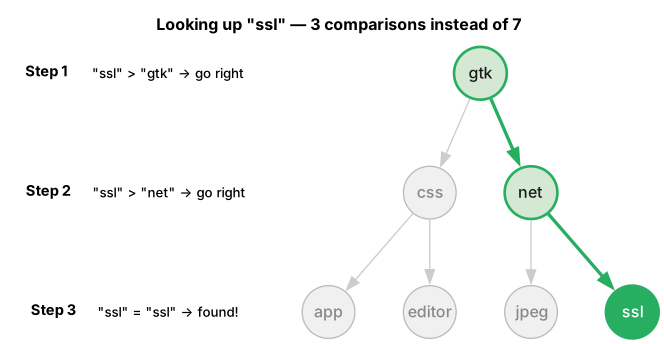
Because the tree stays balanced, every lookup follows a single path from root to leaf. The length of that path is at most log₂(n) — with 10,000 entries, an AVL lookup visits at most 14 nodes instead of scanning all 10,000.
portage-ng uses association lists extensively — for the proof, the model, the trigger set, and the constraint store:
?- empty_assoc(E),
   put_assoc(editor, E, installed, A1),
   put_assoc(browser, A1, pending, A2),
   get_assoc(editor, A2, Status).
Status = installed.
All operations (get_assoc, put_assoc) are O(log n), which makes them
practical for the data structures at the heart of the prover.
Definite Clause Grammars
When portage-ng reads a package's dependency specification, it needs to
parse structured text like >=dev-libs/openssl-1.1:0= into Prolog terms
the prover can reason about. In most languages, writing a parser means
writing imperative code — loops, state machines, error handling. In Prolog,
you can write the grammar itself as a program.
A DCG (Definite Clause Grammar) lets you describe what valid input looks like, declaratively. Prolog takes care of matching the input against the grammar rules. For example, a simple grammar for a greeting:
greeting --> [hello], name.
name --> [world].
name --> [prolog].
This reads naturally: "a greeting is the word hello followed by a name;
a name is either world or prolog." To check whether a sequence matches:
?- phrase(greeting, [hello, world]).
true.

?- phrase(greeting, [hello, cat]).
false.
The grammar is the parser — there is no separate parsing step. portage-ng uses DCGs to parse the EAPI (Ebuild API) dependency specification language — EAPI is the versioned interface that defines the syntax and semantics of Gentoo's ebuild format, including version ranges, Use conditionals, slot operators, and choice groups. The result is a parser that reads like a specification of the language it accepts, making it easier to verify, extend, and maintain.
Meta-programming
One of Prolog's most distinctive features is that programs and data are made
of the same material: terms. A rule like requires(browser, graphics)
is not just an instruction — it is a data structure that a program can
inspect, build, and pass around. This blurs the line between "the program"
and "the data it operates on" in a way that is natural in Prolog but
awkward in most other languages.
Why does this matter for portage-ng? Because the prover does not just compute a plan — it builds a proof that explains why the plan is correct. As the prover works, it constructs a term that records every decision:
proof(browser, [
  rule(requires(browser, graphics), [
    proof(graphics, [
      rule(requires(graphics, fonts), [
        proof(fonts, [fact])
      ])
    ])
  ])
]).
This proof term says: "the browser is in the plan because it requires graphics, which is in the plan because it requires fonts, which is a base fact." The proof is not a side effect or a log — it is a first-class Prolog term that can be queried, compared, and transformed like any other data.
The same principle applies to assumptions. When the prover cannot satisfy a dependency without, say, accepting a testing keyword, it records that assumption as a term inside the proof:
assumed(accept_keywords('~amd64', graphics))At the end, portage-ng can walk the proof, collect all assumptions, and present them to the user as actionable suggestions — precisely because assumptions are data, not scattered side effects.
This capability is called reification: turning the process of reasoning into data that can itself be reasoned about. It is what makes the "every plan is a proof" architecture natural in Prolog.
Why Prolog?
Now that you have seen the basics, here is why Prolog is not just a possible implementation language but the right one for building a reasoning engine for software configuration management.
The primitives match the problem
A reasoning engine for configuration management needs a small set of core operations. In Prolog, these operations are built-in primitives rather than library code:
| Reasoning need | Prolog primitive |
|---|---|
| Configuration rules | Horn clauses |
| Structured data | Compound terms |
| Search with backtracking | Built-in backward chaining with backtracking |
| Constraint propagation | Unification and association lists |
| Specification grammar | Definite Clause Grammars |
| Proof construction | Terms as data (reification) |
| Meta-programming | Runtime assertion and introspection |
Imperative package managers must re-implement all of these. Portage's
depgraph.py implements its own retry loop with mask accumulation.
pkgcore's merge_plan implements its own frame stack and state
checkpoints for backtracking. Paludis's decider.cc implements its
own constraint accumulator with exception-driven restart. All three
re-invent mechanisms that Prolog provides as proven primitives. By
relying on these primitives, the codebase becomes easier to read and
understand — developers can focus fully on declaring domain knowledge
rather than maintaining search and backtracking machinery.
Meta-level reasoning
Beyond the primitives, Prolog enables meta-level reasoning — the ability to reason about the reasoning process itself. For a configuration management engine, this is the decisive advantage.
Reifying assumptions. When the prover cannot satisfy a dependency, it does not throw an error. It records an assumption as a first-class term in the proof tree. The assumption carries structured metadata: why it was made, what alternatives were tried, and what the user can do about it. This is natural in Prolog because proofs are data.
Consider what happens when a package requires a keyword that is not accepted. An imperative resolver would either fail or silently accept the keyword. portage-ng records:
rule(assumed(portage://dev-libs/foo-1.0:run), [])(The real literal's context also carries assumption_reason(...) and
suggestion(accept_keyword, ...) tags.) This assumption appears in the
proof, flows through the plan, and is
presented to the user as: "I assumed dev-libs/foo-1.0 could be merged.
To make this work, I will add it for you to package.accept_keywords."
Inspecting proof trees. The explainer module queries the proof AVL to answer "why is this package in the plan?" without re-running the resolver. In an imperative resolver, this would require instrumenting the search loop with logging and replaying it.
Learning from failures. When a proof attempt fails, the prover extracts a learned constraint — a narrowed version domain — from the failure and carries it into the next attempt. This is analogous to CDCL (Conflict-Driven Clause Learning) in SAT solvers, but expressed as Prolog term manipulation rather than boolean clause generation.
Declarative vs. imperative
The difference is not just stylistic. A declarative specification of configuration rules is:
- Auditable — the rules can be read as logical statements
- Testable — individual rules can be queried in isolation
- Extensible — adding a new dependency type means adding clauses, not modifying control flow
In portage-ng, the entire EAPI specification — hundreds of pages of the PMS (Package Manager Specification, the formal document that defines how Gentoo ebuilds, dependencies, USE flags, slots, and all related metadata must be interpreted) — is captured in a set of DCG grammar rules and Prolog clauses. Each time a new EAPI revision introduces features, supporting them is a matter of adding grammar rules and clauses. The reasoning engine — the prover and the ordering laws — does not change at all, because it is domain-agnostic.
Beyond pure Prolog
Prolog's strengths — backtracking, unification, reification — provide the foundation, but building a large-scale reasoning engine also requires structure that pure Prolog does not offer out of the box. portage-ng extends standard Prolog with two mechanisms: feature terms for carrying structured metadata through proofs, and contexts for organising code into encapsulated, independently stateful components.
Feature logic and feature terms
In classical logic programming, everything is built from terms, and a
term is one of three things. An atom names a specific individual
directly: openssl, amd64, stable. A variable — written with an
initial capital, like Version or X — stands for an individual that is
not yet known; unification may later bind it to a concrete term. A
compound term names an individual by description: a functor applied to
arguments, as in version(2, 4, 1) — "the version with components 2, 4
and 1". Just as the phrase "the mother of John" identifies a person without
stating her name, the compound term mother_of(john) denotes an individual
through its relationship to another one. And because arguments may
themselves be compound, descriptions nest to arbitrary depth —
mother_of(mother_of(john)) is the mother of the mother of John. With
only these three kinds of terms, a finite program can describe and reason
about arbitrarily large — even infinite — domains.
Three kinds of terms are enough for simple reasoning, but when the prover needs to carry configuration alongside identity — "this package, with these USE flags, in this slot, at this proof depth" — a flat compound quickly becomes unwieldy. Feature logic, originally developed by Hassan Aït-Kaci and others for computational linguistics, offers a cleaner model: a feature term is a structured record of named attributes (features) whose values may themselves be feature terms. Two feature terms can be unified (merged) non-destructively, combining their information while checking for consistency.
Andreas Zeller applied feature logic directly to software configuration management, showing that features and feature unification provide a natural formalism for describing and merging software configurations — capturing version selections, build options, and platform constraints as feature terms rather than ad-hoc data structures. portage-ng builds on this insight: USE flags, slot constraints, version domains, and proof context are all represented as feature terms that the prover unifies as it expands the dependency graph.
portage-ng uses the ?{} notation to attach a feature term to any literal.
The syntax reads as "this literal, qualified by these features":
portage://app-editors/neovim-0.12.0:run?{[]}Here the feature term {[]} is empty — no additional constraints beyond the
literal itself. As the prover expands dependencies and resolves USE flags,
the feature term accumulates information:
portage://app-editors/neovim-0.12.0:run?{[nvimpager, naf(test)]}The feature term {[nvimpager, naf(test)]} records that the nvimpager USE
flag is enabled and test is disabled (naf stands for "negation as
failure" — the standard logic-programming notation for default negation).
Feature unification is the operation that merges two feature terms. When the prover encounters the same package from two different dependency paths, each carrying its own feature term, unification combines them:
- Plain items (like USE flags) are collected by union.
- Constrained sets
{L}use intersection semantics — both paths must agree. - Keyed values (
feature:valuepairs) are unified recursively. - If a term and its negation (
naf(X)vs.X) both appear, unification fails — this signals a genuine conflict in the dependency graph.
This mechanism is domain-agnostic: the unifier (Source/Logic/unify.pl) does
not mention USE flags, slots, or ebuilds. It operates on abstract feature
terms. The Gentoo domain layer maps USE flags, slot constraints, and version
domains onto feature terms; the unifier simply merges them. A domain hook
(feature_unification:val_hook/3) allows domain-specific value types (e.g.
version domain intersection) to participate in unification without modifying
the core.
The result is that every literal in a proof carries a complete, machine-readable description of its resolved configuration. The orderer and printer can read this directly — there is no need to re-derive "which USE flags were active" after the fact.
Contextual object-oriented programming
Prolog operates under the closed-world assumption: what cannot be derived from the program is considered false. The classic illustration is an airline database: a flight that is not listed does not exist. Nobody enumerates all the flights that do not operate — absence itself is the negative information. This convention is what makes negation practical, but it carries an obligation: the program must be a complete description of its world. An answer like "no version of this package satisfies the constraint" is only trustworthy if every version the question ranges over is actually in the program.
Now consider the world portage-ng reasons about: multiple repositories, each with tens of thousands of ebuilds, every ebuild in several versions, each version with its own dependencies, USE flags, and keywords — plus profiles, user configuration, and the installed system. Treating all of that as one flat closed world is semantically correct but practically untenable. Facts would have to be discovered lazily from disk in the middle of proofs, so completeness — the very thing the closed-world assumption rests on — could never be guaranteed at any given moment; and every negative answer would implicitly quantify over one enormous, undifferentiated fact base in which most facts are irrelevant to the question being asked.
portage-ng therefore computes a closure before reasoning begins: for each component, the complete set of facts describing it is materialised up front. Syncing a repository parses every ebuild's metadata and asserts the result into that repository's own context; the profile and the user configuration are expanded into theirs; the installed system (VDB) gets its own. Each context is now a small world that is genuinely closed by construction — it contains everything there is to know about its component. Within such a boundary, negation and enumeration are both sound and fast: "no version of X in this repository satisfies C" ranges over exactly one context's in-memory, indexed facts rather than over an open-ended outside world.
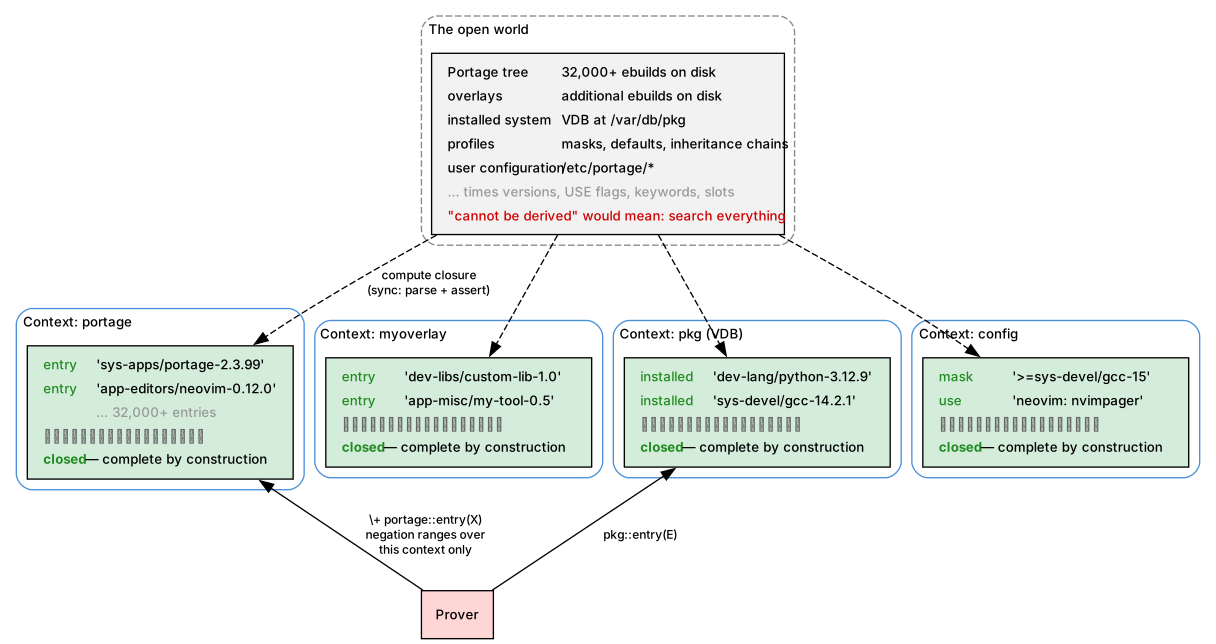
The closed-world assumption still holds — but per context, within a well-defined boundary, which makes reasoning both tractable and modular. What remains is an engineering question: how do we organise these scoped contexts as first-class objects in Prolog?
Standard Prolog module systems offer some namespacing, but they were designed for library organisation, not for modelling independent entities that each carry their own state, rules, and encapsulation boundaries. We need a way for each component to have its own context — its own facts, its own rules — with explicit declarations of what is public interface and what is private implementation. Different repositories and different configurations must be able to coexist without interfering with each other's reasoning.
In the object-oriented world, this problem was solved long ago with encapsulation and access control. The challenge is bringing those organisational benefits to Prolog without sacrificing its declarative nature. The rules inside a context must remain ordinary logical clauses — directly translatable into traditional logic — while the context system provides the structure around them.
portage-ng needed object-oriented style programming — classes, instances, encapsulation, access control — but at runtime, because repositories and configurations are discovered and instantiated at startup, not known at compile time. No existing Prolog library provided this. Logtalk, the best-known approach to object-oriented logic programming, works by compile-time translation: source files are transformed into plain Prolog before execution. That model does not fit a system that creates and composes objects dynamically.
So portage-ng implements its own runtime object system called context
(implemented in context.pl). The syntax is deliberately Logtalk-like
— ::- for method clauses, :: for message sends, dpublic,
dprotected, dprivate for access control — but the underlying
mechanism is entirely different: contexts are created, cloned, and
composed at runtime through Prolog’s own assert/retract machinery.
There is no compilation step and no source-to-source transformation.
To illustrate, here is a simplified example of a person context:
:- module(person, []).
:- class.

:- dpublic([person/1, '~person'/0]).
:- dpublic([get_name/1, set_name/1]).
:- dpublic([get_age/1, set_age/1]).
:- dpublic([get_title/1, add_title/1, remove_title/1]).
:- dprivate(age/1).
:- dprivate(title/1).
:- dprotected(name/1).

person(Name) ::-
  :set_name(Name).

'~person' ::-
  :this(Context),
  write('Person destructor - '), write(Context), nl.

get_name(Name) ::-
  ::name(Name).

set_name(Name) ::-
  <=name(Name).

get_age(Age) ::-
  ::age(Age).

set_age(Age) ::-
  <=age(Age).

get_title(Title) ::-
  ::title(Title).

add_title(Title) ::-
  <+title(Title).

remove_title(Title) ::-
  <-title(Title).

age(Age) ::-
  number(Age), Age > 0.
Several things are worth noting. The :- class directive declares that
this module defines a context class. The dpublic, dprotected, and
dprivate directives specify access control — just like in classical OO,
public predicates can be called by anyone, protected predicates only by the
class and its descendants, and private predicates only within the class
itself. The constructor person/1 initialises the instance by setting its
name; the destructor ~person is called when the instance is destroyed.
The ::- operator (instead of Prolog's standard :-) marks instance
methods: their clauses are guarded at runtime so that each instance operates
on its own state. The :: prefix reads instance data, <= assigns it
(replacing any previous value), <+ adds a fact to the instance, and <-
removes one — as shown by add_title and remove_title, which allow a
person to accumulate multiple titles. The : prefix calls other methods
on the same instance.
Using this class is straightforward:
?- pieter:newinstance(person).
true.

?- pieter:person('Pieter').
true.

?- pieter:set_age(40).
true.

?- pieter:add_title('Dr.').
true.

?- pieter:add_title('Prof.').
true.

?- pieter:get_age(Age).
Age = 40.

?- pieter:get_title(Title).
Title = 'Dr.' ;
Title = 'Prof.'.
The newinstance call creates an instance named pieter from the
person class, and the constructor is invoked with pieter:person('Pieter').
From that point on, pieter is a live context with its own state.
Setting the age and adding titles modifies that instance's private data.
Querying titles backtracks over all titles that were added — this is
Prolog's backtracking working naturally within the context system.
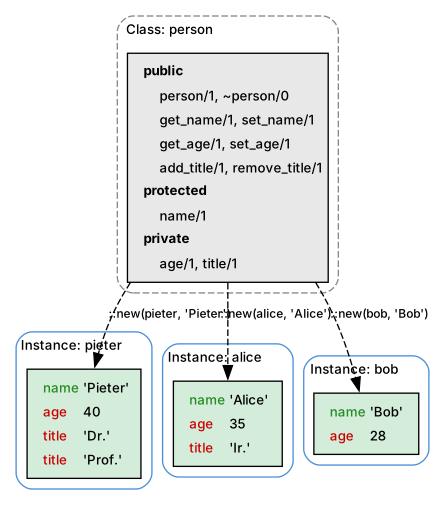
Each instance carries its own state: pieter has two titles and age 40,
alice has one title and age 35, bob has no titles and age 28. The
class defines the shape; each instance fills it independently.
In portage-ng, repositories are context objects: each has a name, a set of
entries, and operations like sync, graph, and query that are dispatched
through the context. The prover does not need to know which repository it
is reasoning about — it receives a context and operates through it.
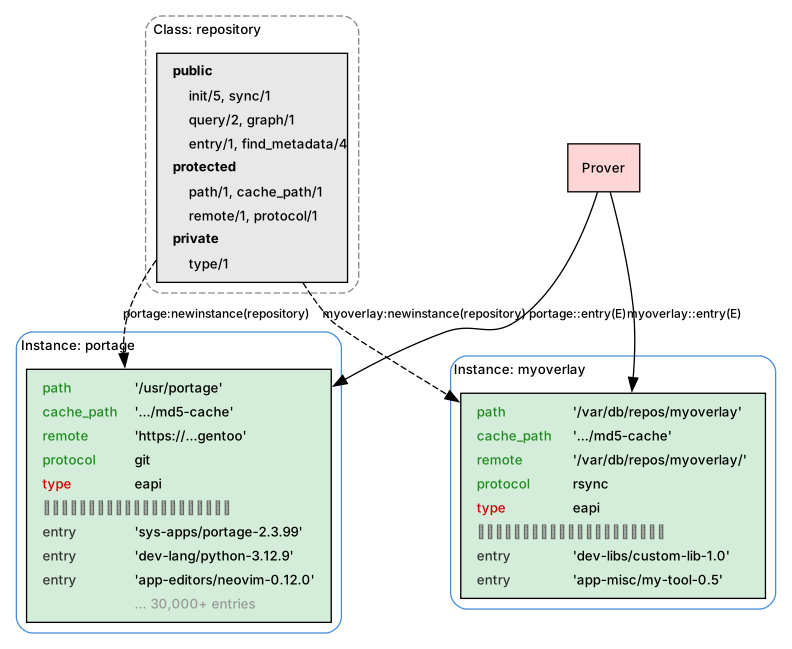
The repository class defines the interface — init, sync, entry,
query — while each instance holds its own path, protocol, and entries.
The prover queries portage:entry(E) and myoverlay:entry(E) through
the same module-qualified call; the context system dispatches each call
to the right instance's private data.
This approach brings encapsulation, polymorphism, and modularity to Prolog while preserving its declarative core. The rules inside a context are ordinary Prolog clauses; the context system simply controls visibility and dispatches calls to the right instance. The full design is covered in chapters 21 and 22.
The ::- operator is also portage-ng's logo — the banner printed at
startup reads ::- portage-ng. The symbolism is deliberate. Prolog
writes the implication arrow of a logical rule as :-. The double colon
:: is the scope operator of the object-oriented tradition — and, by a
happy coincidence, the repository qualifier every Gentoo user knows from
atoms like dev-lang/python::gentoo. Superimpose the two, sharing the
middle colon, and you get ::-: a logical rule that holds within a
context. Contextual logic programming, applied to Gentoo — the whole
project in three characters.
Feature logic meets contextual logic
There is a natural synergy between feature logic and contextual logic programming that is worth noting. A context — with its named attributes, access control levels, and instance-specific state — can be viewed as a special kind of feature term: a structured record of features (name, age, title, path, protocol, ...) augmented with meta-level annotations (public, protected, private) that control which features are visible to which parts of the program. Conversely, feature unification can be seen as a restricted form of context composition: merging two feature terms is analogous to combining two contexts, with consistency checking playing the role of access control.
This perspective suggests that feature logic and contextual logic programming are two views of the same underlying formalism — one emphasising data (feature terms as structured records) and the other emphasising behaviour (contexts as encapsulated reasoning units). A unified framework that captures both would be a natural extension: feature terms with access-controlled attributes, or contexts whose state is described and merged via feature unification. This remains an open area for further exploration.
Pengines: contexts over the network
SWI-Prolog provides Pengines (Prolog Engines) — lightweight, sandboxed Prolog instances that can be created, queried, and destroyed over HTTP. Each Pengine is an isolated reasoning environment with its own clause store, running inside a host server process. Clients on remote machines can create a Pengine, send it a query, and receive results — all over a standard HTTPS connection.
The connection to contextual logic programming is direct: a Pengine is, in essence, a remote context. Just as a local context encapsulates its own state and exposes a public interface, a Pengine encapsulates a Prolog environment and exposes it over the network. The access control that contexts provide locally (public, protected, private) is mirrored by the Pengine sandbox, which restricts which predicates the remote client may call.
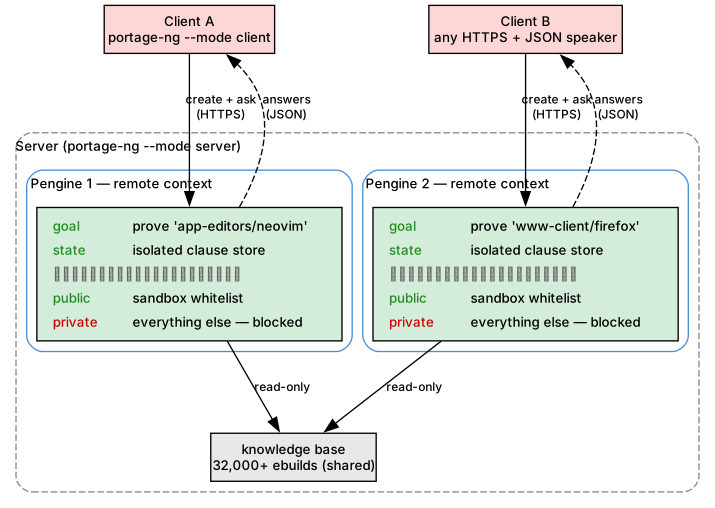
Each client interaction gets its own Pengine: an isolated goal, its own clause store, and a sandbox whitelist as its public interface. Both Pengines read the same shared knowledge base, but neither can modify the server nor observe the other — exactly the encapsulation a local context provides, transported over HTTPS.
portage-ng uses Pengines in its server mode. The server hosts the knowledge base and exposes it through a Pengine application: clients and workers create Pengines on the server, submit proving goals, and receive plan results — all without needing a local copy of the knowledge base. From the client's perspective, the interaction looks like a local Prolog query; the network transport is transparent. This is what makes client–server mode practical for embedded and resource-constrained devices: the full reasoning context lives on the server, and the client merely drives it.
The "every plan is a proof" philosophy
These ideas come together in portage-ng's central insight: a build plan should not be the output of a search algorithm that happens to terminate. It should be a proof object — a term that records, for every package, which rule justified its inclusion and under what constraints.
This gives three properties that traditional resolvers lack:
Completeness. If a valid plan exists, the prover finds it. If no valid plan exists, the prover completes with explicit assumptions that document exactly where the specification is unsatisfiable.
Explainability. Every package in the plan can be traced back through the proof tree to the user's original target. "Why is this package here?" is answered by inspecting the proof, not by re-running the resolver.
Reproducibility. The proof is a first-class Prolog term. Given the same Portage tree, VDB, and configuration, the same proof is produced every time.
How portage-ng relates to other resolvers
portage-ng is not a rewrite of Portage in Prolog. It is a fundamentally different approach to the same problem:
| Portage | pkgcore | Paludis | portage-ng | |
|---|---|---|---|---|
| Language | Python | Python | C++ | SWI-Prolog |
| Model | Greedy graph + retry | Frame-stack DFS + backtrack | Constraint accumulator + restart | Inductive proof search |
| Conflicts | Retries with mask accumulation | Backtrack to frame checkpoint; next choice | Restarts with preloads | Iterative refinement with learned domains |
| Completeness | Sometimes fails | Sometimes fails | May exhaust restarts | Always produces a plan |
| Guarantees | None | None | None | Every plan is a proof |
For a detailed comparison of the reasoning models, see Chapter 23: Resolver Comparison.
A brief history
The author's involvement with Gentoo began in 2002 as the founder of the first architecture port — PowerPC. That work contributed to the keyword system described above and to expanding the range of platforms where Gentoo could run. In 2003, a formal top-level management structure was implemented for the Gentoo project (GLEP 4). Under this structure, the author served as a senior manager for Gentoo with both strategic and operational responsibility for three areas: Gentoo on alternative operating systems and LiveCD technology, developer tools, and package manager research (Portage). That experience — porting across architectures, managing the resulting configuration complexity, and researching the limits of Portage's imperative resolver — motivated the portage-ng project.
portage-ng began in 2005 as an experiment in applying logic programming to software configuration management. The initial question was simple: could Prolog's built-in search and backtracking replace the hand-written solver in Portage?
The answer turned out to be deeper than expected. Prolog did not just replace the solver — it changed what was possible. The ability to reify proofs meant build plans became inspectable objects. The ability to record assumptions meant the resolver never had to give up. The ability to parse grammars with DCGs meant the EAPI specification could be expressed directly as code.
Over two decades of development, portage-ng has evolved from a proof-of-concept into a full-featured configuration management front-end with full PMS / EAPI compliance, distributed proving, LLM-assisted plan explanation, and measured correctness against Portage across the entire Gentoo tree.
Further reading
- Chapter 2: Installation and Quick Start — getting portage-ng running on your machine
- Chapter 4: Architecture Overview — how the six pipeline stages fit together
- Chapter 8: The Prover — the inductive proof engine in detail
- Chapter 23: Resolver Comparison — deep dive into how portage-ng compares with Portage, Paludis, and pkgcore
- Chapter 25: Position in the Solver Literature — where the prover sits among feature logic, ordered logic, answer-set solvers and the package solvers that followed them