Assumptions and Constraint Learning
Always a proof, never a dead end
Most dependency resolvers stop when they cannot satisfy a constraint: no solution, no plan, and often little more than a terse error. portage-ng takes a different stance. It does not give up. When every above-board alternative has been exhausted, the prover records an assumption — effectively: “I am proceeding as if this dependency could be satisfied” — and continues building the proof.
The outcome is always a complete plan. Either the proof is strict (no assumptions), or it is a proof under assumptions, with the unresolved fragments called out explicitly. Assumptions are not treated as opaque failures; they are proposals. They tell you which pieces of configuration or tree state would need to change for the same reasoning chain to become a strict proof. This is the same habit of mind as in mathematics: “Assuming the Riemann hypothesis, we can prove …” — the argument is valid conditional on the assumptions; make them true, and the condition disappears.
The sections below walk through a concrete missing-dependency example, then explain how suggestion tags turn assumptions into actionable hints. After that, the chapter documents the same mechanisms in technical detail: assumption taxonomy, reprove loop, REQUIRED_USE flow, entry rules, constraint guards, progressive relaxation, assumption printing, and the analogy to conflict-driven clause learning.
Worked assumption example: missing dev-libs/foo
Suppose the user runs:
portage-ng --pretend some-packageand some package in the graph depends on dev-libs/foo, which has no
ebuild in any repository the knowledge base knows about.
What the prover does
- The grouped package dependency rule tries to prove the dependency
by enumerating candidates for category
dev-libsand namefoo. - Search returns no entries — there is nothing to install, so every candidate path fails.
- After backtracking exhausts those paths, the fallback chain runs (parent narrowing, reprove with learned domains, and so on, as documented below). None of that invents a missing package.
- The domain layer finally takes the assumption path: it builds a
condition whose head is
assumed(grouped_package_dependency(…)), tags the proof-term context with a reason (and optional suggestions), and the catch-all rulerule(assumed(_), [])lets the prover close that branch of the proof.
What appears in the Proof AVL
The proof tree stores a domain assumption with a key of the form
rule(assumed(Lit)), where Lit is the grouped-dependency literal. For
example (category and name as atoms, dependency list abbreviated):
rule(assumed(grouped_package_dependency('dev-libs', 'foo', …):config?{Ctx}))
    → dep(0, [])?Ctx
The exact Action (:config, :install, :run, …) depends on which
phase of the grouped dependency is being proved; the important invariant
is the rule(assumed(...)) proof key (see Assumption Taxonomy).
What the user sees in the plan output
The printer classifies this as a non-existent dependency and emits a Domain assumptions block, along the lines of:
Domain assumptions: dev-libs/foo (non-existent)Exit code
When any domain assumption is present, the CLI exit code is 2
(cycle-break-only assumptions alone yield 1; a fully strict proof
yields 0).
How to read it
The message is intentionally operational: to resolve this assumption,
ensure dev-libs/foo is available in your repository (overlay,
third-party tree, or corrected package name). The plan is still a
single coherent merge order; the assumption marks the gap between what the
prover can justify from facts and what you must supply from outside.
Assumptions as actionable proposals
Many assumptions carry suggestion(Type, Detail) (and related) tags
in the literal’s ?{Context} list. These encode configuration
changes that would move the proof toward strictness — often the same
changes the progressive relaxation tiers simulate when you widen
assuming/1 flags.
Typical shapes in the codebase include:
| Tag (representative) | User-facing intent |
|---|---|
suggestion(keyword, '~amd64') |
Accept the unstable keyword — e.g. add to package.accept_keywords (in sources: suggestion(accept_keyword, '~amd64')) |
suggestion(unmask, …) |
Unmask the package — e.g. package.unmask (Repo://Entry when known) |
suggestion(use, …) |
Adjust USE flags — e.g. package.use (in sources: suggestion(use_change, Repo://Entry, Changes)) |
When you run in modes that apply suggestions (see the builder’s
execute_suggestion/… hooks), those changes are already reflected in
the plan; your job is to review and approve them in your real
/etc/portage layout, or to treat the tags as a checklist for manual
edits. Progressive Relaxation ties the same
ideas to the assuming tiers (keyword_acceptance, blockers, unmask).
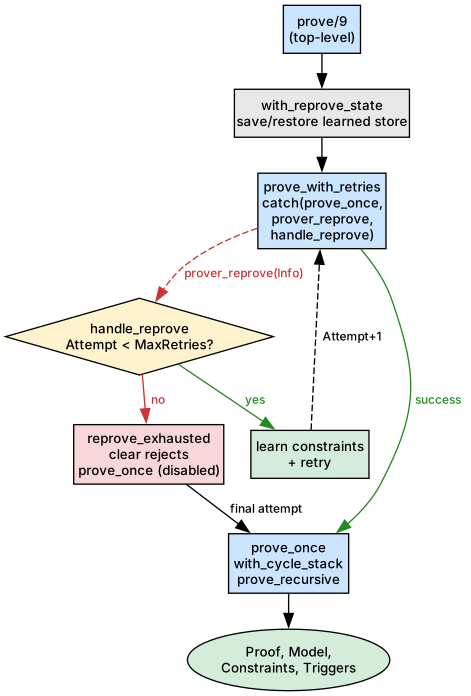
Overview
The portage-ng prover builds a formal proof that a set of target packages can be installed. The proof is an AVL tree mapping literals to their justifications. When part of the dependency graph cannot be satisfied, the prover records assumptions — lightweight markers that let the proof complete while flagging the unresolved fragment for the user.
Two fundamentally different kinds of assumptions exist, and a bounded reprove mechanism allows the prover to retry the proof with accumulated knowledge before resorting to assumptions.
Data Structures
The prover maintains four AVL trees during proof construction:
| AVL | Key → Value | Purpose |
|---|---|---|
| Proof | rule(Lit) → dep(N, Body)?Ctx |
Which rule justified Lit |
| Model | Lit → Ctx |
Every proven literal + context |
| Constraints | constraint key → value | Accumulated constraint terms |
| Triggers | BodyLit → [HeadLit, …] |
Reverse-dependency index |
Assumption Taxonomy
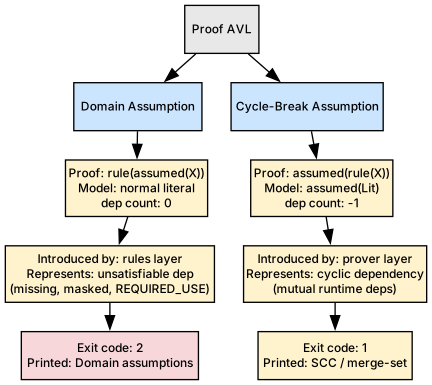
The two kinds of assumptions are stored differently in the Proof and Model trees. Confusing them leads to wrong statistics, wrong plan output, or missed warnings.
Domain Assumptions (rule(assumed(X)))
Introduced by the rules layer when a dependency cannot be satisfied — for example, a package that does not exist in the tree, or a REQUIRED_USE violation that makes every candidate invalid.
How they are created:
The grouped_package_dependency rule exhausts all candidates (via
Prolog backtracking), then the fallback chain (parent narrowing →
reprove → assumption), and finally emits:
Conditions = [assumed(grouped_package_dependency(C,N,Deps):Action?{Ctx})]The assumed(X) literal in the body is proved by the catch-all rule:
rule(assumed(_), []) :- !.This stores rule(assumed(X)) in the Proof tree.
Where they appear:
- Proof:
rule(assumed(X))→dep(0, [])?Ctx - Model:
assumed(X)→Ctx(theassumed(X)body literal is proved as a regular literal; exit-code detection scans for these keys) - Plan: rendered as "verify" steps + "Domain assumptions" warning block
Prover Cycle-Break Assumptions (assumed(rule(X)))
Introduced by the prover when it detects a cycle during proof search. If a literal is already on the cycle stack (currently being proved), the prover cannot recurse further without diverging. Instead, it records a cycle-break:
put_assoc(assumed(rule(Lit)), Proof, dep(-1, OldBody)?Ctx, Proof1),
put_assoc(assumed(Lit), Model, Ctx, NewModel)
Where they appear:
- Proof:
assumed(rule(Lit))→dep(-1, Body)?Ctx - Model:
assumed(Lit)→Ctx - Plan: ordered normally by the ordering pass; cycle explanation via
the printer's cycle section (
Printer/Plan/cycle.pl)
Summary Table
| Property | Domain Assumption | Prover Cycle-Break |
|---|---|---|
| Proof key | rule(assumed(X)) |
assumed(rule(X)) |
| Model key | assumed(X) |
assumed(Lit) |
| dep count | 0 | -1 |
| Introduced by | rules layer | prover layer |
| Represents | unsatisfiable dependency | cyclic dependency |
| Printed as | "Domain assumptions" | cycle break |
| Exit code contribution | 2 | 1 |
Reprove Mechanism
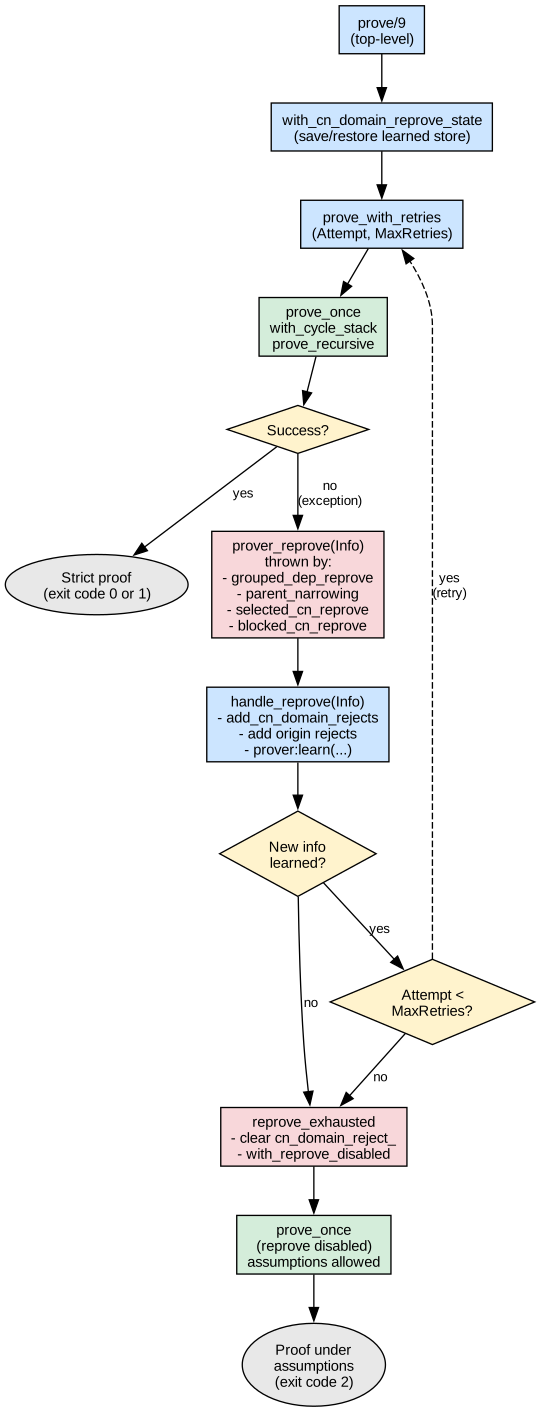
When a conflict is detected during proof search, the domain layer does not simply fail — it records what went wrong and requests a retry with refined knowledge.
Triggering Reprove
Several predicates can throw prover_reprove(Info):
| Source | When |
|---|---|
maybe_learn_wildcard_domain |
Wildcard dep fails and parent already narrowed or single-version; learns upper-bound cn_domain from wildcard |
maybe_learn_parent_narrowing |
Parent introduced a dep that made (C,N) unsatisfiable; rejects the exact parent entry |
maybe_request_grouped_dep_reprove |
Effective domain conflicts with selected CN; domain inconsistent; version/slot constraints present |
selected_cn_unique_or_reprove |
CN-domain constraint conflicts with already-selected candidate (constraint guard) |
selected_cn_not_blocked_or_reprove |
Blocker detected via blocked source snapshot |
Each throws prover_reprove(cn_domain(C, N, RejectDomain, Candidates, Reasons)).
Handling Reprove
When prove_with_retries catches a prover_reprove(Info) exception,
it delegates to heuristic:handle_reprove/2, which proceeds in three
steps:
Record what went wrong. The handler extracts the conflicting category, name, domain, and candidate list from
Infoand adds them to a reject set (memo:cn_domain_reject_). If the conflict was introduced by a specific parent, that origin is also recorded so the prover avoids the same path on the next attempt.Decide whether to retry. If new information was actually learned (
Added = true) and the attempt count is still belowreprove_max_retries, the handler restarts the proof from scratch by callingprove_with_retrieswith an incremented attempt counter. The learned rejects carry over, so the prover will not repeat the same conflict.Give up gracefully. If nothing new was learned, or the retry budget is exhausted, the handler calls
reprove_exhausted, which clears the reject set so the final attempt runs unbiased. It then invokesprove_oncewith reprove disabled — no furtherprover_reproveexceptions can be thrown, so the proof completes with assumptions where necessary.
Learned Constraint Store
The prover:learn/3 and prover:learned/2 predicates maintain a
key-value store that persists across reprove retries within the same
top-level prove/10 invocation. This is distinct from the reject set
(which accumulates and is cleared on exhaustion).
The domain uses learned constraints for:
- Candidate narrowing —
grouped_dep_effective_domainintersects the local+context domain with any learned domain. - Conflict learning — constraint guards learn the domain when a conflict is detected.
- Parent narrowing —
maybe_learn_parent_narrowingexcludes the parent version when a child dep cannot be satisfied. This one does not go through the learned store: a version domain cannot express a hole, and a< ParentVercut would also discard every newer parent version that was still eligible. The exact parent entry is placed in the reject map instead. - Wildcard failure learning —
maybe_learn_wildcard_domainderives an upper-bound domain from a wildcard constraint (e.g.=pkg-0.6*→< 0.7) when parent narrowing alone could not resolve the conflict.
Retry Budget
reprove_max_retries defaults to 20 (configurable via
config:reprove_max_retries/1). The final attempt runs with reprove
disabled so the proof can complete with assumptions if necessary.
Before it runs, heuristic:reprove_exhausted/0 clears the reject map
(including the parent-narrowing rejects) so the final pass starts from
a clean candidate set; only the learned constraint store survives.
Keeping the parent-narrowing rejects alive across exhaustion was
measured tree-wide and rejected: it fixed 3 targets but added NEGATIVE
assumptions in 48 and changed them in 75 more.
Use model violation flow
When a parent package forces USE flags on a dependency via bracketed USE
deps (e.g. cat/pkg[feature]), and the dependency's REQUIRED_USE
forbids that flag combination, the REQUIRED_USE violation mechanism
ensures the prover explores alternatives before assuming.
Step-by-step flow
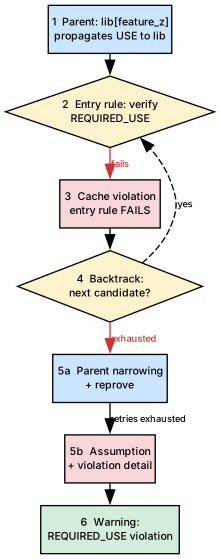
The diagram above shows the six stages the prover walks through when a parent forces a USE flag that violates a dependency's REQUIRED_USE. Each step is explained below.
Step 1 — USE propagation.
The parent atom cat/app depends on cat/lib[feature_z].
The bracketed flag is carried forward as a build_with_use context
annotation, so every candidate version of lib will be evaluated with
feature_z enabled.
Step 2 — Entry rule verification.
When lib's :install (or :run) entry rule fires, it computes the
full USE model and calls use:verify_required_use_with_bwu to check
whether the resulting flag set satisfies lib's REQUIRED_USE
expression.
Step 3 — Fail, not assume.
If verification fails (e.g. lib declares REQUIRED_USE=!feature_z),
the entry rule caches a structured violation description via
memo:requse_violation_/3 and then fails. It does not produce an
assumption, because doing so would hide the failure from the candidate
selection logic and bypass the entire reprove mechanism.
Step 4 — Candidate backtracking.
The failure propagates back to grouped_package_dependency, which tries
the next candidate version of lib. A different version may have a
different REQUIRED_USE that does not conflict with feature_z.
Step 5a — Parent narrowing + reprove.
When all candidates are exhausted, the fallback chain activates.
maybe_learn_parent_narrowing rejects the current parent entry
(app-1.0) and throws prover_reprove, giving the prover a
chance to retry with a different parent that may not force feature_z.
Step 5b — Assumption with violation detail.
After all reprove retries are exhausted, the prover falls through to the
assumption path. explanation:assumption_reason_for_grouped_dep
retrieves the cached requse_violation_ info and enriches the
assumption context with a required_use_violation(...) tag.
Step 6 — Warning output. The printer recognises the enriched context and emits a structured REQUIRED_USE violation warning, showing which flags were forced, what expression they violate, and which parent triggered the conflict.
Memo cache
The violation info is cached via memo:requse_violation_/3 (thread-local,
survives backtracking since assertz is side-effecting). It is:
- Asserted in the entry rule before failing
- Consumed in the
grouped_package_dependencyassumption path (retracted after enriching the context) - Cleared by
memo:clear_caches/0at the start of each proof run
Entry rule structure
Every :install and :run entry rule follows the same layered
structure. Understanding this structure is important because it
explains when the prover fails, when it assumes, and why the
distinction matters.
Gate checks.
The rule begins with a deterministic cut (!) — there is exactly one
entry-rule clause per literal form, so Prolog must not search for
alternatives at this level. Candidate alternatives are provided one
level up by grouped_package_dependency. After the cut, three quick
gate checks run in order:
- Mask gate — if the ebuild is masked and the
unmaskrelaxation tier is not active, the rule fails immediately. - Keyword gate — if no accepted keyword exists and
keyword_acceptanceis not active, the rule fails. - Already-installed short-circuit — if the package is already
installed (and
--emptytreewas not requested) with USE flags that match the request, the rule succeeds with an empty condition list. When the installed USE differs, the entry is re-emitted as a transactional:updateaction instead (portage-ng#85).
USE model verification.
When none of the gates apply, the rule queries the ebuild's metadata
and computes the full USE model (combining profile defaults,
user overrides, and build_with_use annotations from the parent).
It then checks the result against the ebuild's REQUIRED_USE
expression. If the check fails, the violation is cached
(memo:requse_violation_/3) and the rule fails — not assumes — so
that backtracking can explore other candidate versions (see section
9.8.1).
Dependency model construction. If the USE model passes, the rule builds the dependency model: it looks up cached or freshly computed dependency lists, orders them, and returns the full condition list (selected CN, constraints, download literal, dependency literals, etc.).
If the dependency model itself cannot be built — for example because
every branch of an any_of_group is filtered out — the rule produces
a domain assumption tagged with issue_with_model. This is
deliberately an assumption rather than a failure, because the problem
is intrinsic to the ebuild metadata, not something that trying a
different candidate version would resolve.
Constraint guards and reprove integration
Every time the prover unifies a new constraint term into the proof, it
calls heuristic:constraint_guard(Key, Constraints) to verify that the
constraint is consistent with what has already been proved. The guard
has three possible outcomes:
- Succeed silently — the constraint is compatible and the proof continues normally.
- Fail — the constraint conflicts with the current proof state. Prolog's built-in backtracking explores an alternative within the same proof attempt (e.g. a different candidate version).
- Throw
prover_reprove(...)— the conflict cannot be resolved by simple backtracking. The prover catches the exception, records a learned constraint, and restarts the proof from scratch with the new knowledge (see section 9.7).
Three specialised guards in cnselect.pl cover the most common
conflict types:
selected_cn_unique_or_reprovechecks that the selected category/name pair is consistent with prior selections. If two dependency paths select different versions of the same package in the same slot, this guard detects the inconsistency and triggers a reprove with a narrowed domain.selected_cn_not_blocked_or_reproveenforces blocker constraints. When a package is blocked by another package that has already been selected, this guard triggers a reprove so the prover can learn to avoid the blocked combination.maybe_request_cn_domain_reprovehandles remaining domain inconsistencies. If the selected version falls outside the intersection of all accumulated version domains, the guard learns the correct domain and triggers a reprove.
The constraint guards above operate within a single proof attempt. But what happens when the entire proof cannot succeed under strict constraints? Rather than immediately falling through to assumptions, the pipeline offers one more tool: progressive relaxation.
Progressive Relaxation
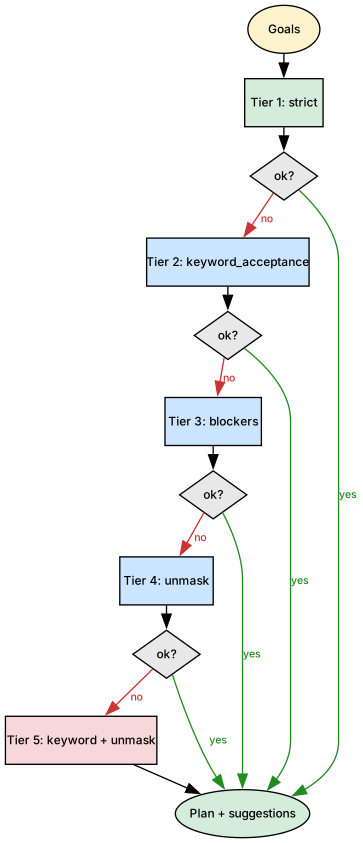
Not every dependency graph can be satisfied under the strictest interpretation of the repository metadata. A package may exist only with an unstable keyword, or be masked by the profile, or conflict with an already-installed blocker. Rather than giving up at the first such obstacle, the pipeline applies progressive relaxation: it re-runs the entire proof under successively weaker constraints until a complete plan emerges.
The mechanism lives in the pipeline's shared fallback driver
(pipeline:fallback_tiers/1 + pipeline:with_fallback/2), used by both
prove_plan_with_fallback/5 and prove_with_fallback/4. Each
tier wraps the prover call inside prover:assuming/2, which sets a
dynamic flag that the domain rules consult at decision points.
| Tier | assuming flag |
What is relaxed |
|---|---|---|
| 1 (strict) | none | All masks, keywords, and blockers enforced |
| 2 | keyword_acceptance |
Unstable keywords (~amd64) accepted |
| 3 | blockers |
Blocker constraints downgraded to warnings |
| 4 | unmask |
Masked packages unmasked |
| 5 | keyword_acceptance + unmask |
Both relaxations combined (last resort) |
The tiers are tried in order via Prolog's committed-choice
if-then-else (-> / ;) — the first tier that succeeds commits
and returns a FallbackUsed tag (false, keyword_acceptance,
blockers, unmask, or keyword_unmask).
The same 5-tier fallback chain is shared by two canonical entry points in the pipeline module:
prove_plan_with_fallback/5— full pipeline (prove + order), used by production paths (--pretend,--graph,--build).prove_with_fallback/4— resolve pass only (no ordering pass), used by layered tests (resolver:test,orderer:test) and--bugs. Each test layer adds its own stages on top.
How assuming/2 works
prover:assuming(Flag, Goal) stores a dynamic flag
(prover_assuming_<Flag>) for the duration of Goal, using
setup_call_cleanup to guarantee cleanup even on exceptions. Domain
predicates test this flag with the unary
prover:assuming(Flag):
candidate:eligible/1— whenkeyword_acceptanceis active, candidates with any keyword are accepted; whenunmaskis active, masked candidates pass.acceptance:accepted_keyword_candidate/7— two fallback clauses widen the candidate pool: one for unstable keywords, one for masked packages.candidate:assume_blockers/0— returnstruewhen blocker constraints should become warnings instead of hard failures.
Suggestion tags
When a relaxation flag is active and a candidate is admitted under that
relaxation, the domain tags the literal's context with a
suggestion/2 term that records exactly which configuration change
would eliminate the need for the relaxation:
| Suggestion tag | Meaning | Target file |
|---|---|---|
suggestion(accept_keyword, '~amd64') |
Accept the unstable keyword | package.accept_keywords |
suggestion(unmask, R://E) |
Unmask the package | package.unmask |
suggestion(use_change, R://E, Changes) |
Adjust USE flags | package.use |
These tags flow through the proof into the plan output. In builder
mode, builder:dispatch_suggestions/3 can apply the suggestions
automatically (writing to /etc/portage/package.* files); in pretend
mode, they appear as actionable hints in the plan output.
Formal guarantee
Each tier still produces a complete proof — the plan is always coherent and fully ordered. The relaxation only widens the candidate pool; it does not skip proof obligations or bypass constraint guards. The suggestion tags make it possible to trace back every relaxation to a concrete configuration change, so the weaker proof can be strengthened incrementally.
Once the proof is complete — whether strict or under assumptions — the results must be communicated to the user. The assumption printing pipeline inspects the Proof AVL and translates each assumption into a classified, actionable message.
Assumption printing pipeline
After the proof is complete, the printer walks the Proof AVL and collects every entry that represents an assumption. Assumptions fall into two families, and the printer handles them differently.
Domain assumptions are stored under rule(assumed(X)) keys. These
represent situations where the prover could not find a real rule and
had to accept the literal on faith. When the printer encounters one,
it inspects the literal and its context to classify the assumption and
produce a meaningful message:
- REQUIRED_USE violation — the context contains a
required_use_violation(...)tag (see section 9.8.1). The printer emits a structured block showing which USE flags were forced, whichREQUIRED_USEexpression they violate, and which parent caused the conflict. - Non-existent dependency — the literal is a
grouped_package_dependencywithout context. This means no candidate version exists at all (the category/name is not in the repository). - Grouped dependency with reason — the literal is a
grouped_package_dependencywith anassumption_reasontag in its context. The printer extracts the reason label (e.g. "all candidates masked", "blocker conflict") and shows it alongside the dependency. - Model unavailable — the context contains
issue_with_model. The dependency model could not be built (e.g. allany_of_groupbranches were filtered). The printer reports this as a metadata problem. - Generic — any domain assumption that does not match the above patterns is printed with the raw literal for debugging.
Cycle-break assumptions are stored under assumed(rule(X)) keys.
These mark points where the prover broke a dependency cycle by assuming
a literal that was already being proved. The printer delegates to
cycle:print_cycle_explanation, which reconstructs the cycle path and
explains which packages form the loop.
Assumption type classification
The classification logic lives in assumption.pl. Given an assumption
literal and its context, it returns a type tag that the warning printer
uses to select the appropriate output format:
| Pattern | Type tag |
|---|---|
Context contains required_use_violation |
required_use_violation |
grouped_package_dependency (no context) |
non_existent_dependency |
grouped_package_dependency (with context) |
Extracted from assumption_reason |
R://E:install |
assumed_installed |
R://E:run |
assumed_running |
| Blocker literal | blocker_assumption |
Context contains issue_with_model |
issue_with_model |
The combination of learned constraints, constraint guards, and progressive relaxation is reminiscent of a well-known technique from the SAT solving world.
Conflict-driven clause learning connection
The learned constraint store is analogous to CDCL (Conflict-Driven Clause Learning) in SAT solvers, but expressed as version domains rather than boolean clauses:
| CDCL concept | portage-ng equivalent |
|---|---|
| Conflict analysis | Constraint guard detecting domain inconsistency |
| Learned clause | prover:learn(cn_domain(C,N,S), NarrowedDomain, _) |
| Unit propagation | grouped_dep_effective_domain applying learned domains |
| Restart | prover_reprove catch-and-retry loop |
| Decision level | Reprove attempt number |
The key difference is granularity: CDCL operates on boolean variables, while portage-ng operates on version domains — structured sets that carry more information per constraint.
With the proving and output mechanisms described, the following sections cover practical aspects: a testing checklist to catch regressions, and a source file map for navigating the codebase.
Testing learned constraints
When testing changes to the reprove or assumption mechanism, the following checklist helps catch regressions quickly:
- Exit code — the process exit code summarises the proof outcome:
0— no assumptions at all (clean proof)1— only prover cycle-break assumptions2— at least one domain assumption (e.g. missing dependency)
- "Total: N actions" — this line must appear in the output, confirming that the proof completed and a plan was produced.
- "non-existent" count — count the lines containing "non-existent" to check how many domain assumptions were made. An unexpected increase signals a regression.
- No "Unknown message" — the output should not contain "Unknown message" or unhandled exception traces. These indicate an assumption type that the printer does not recognise.
- Runtime — a single-target proof should complete within a few seconds. A significant increase compared to previous runs suggests excessive reprove retries or a learning bug.
- Test suite — the overlay and portage test suites
(
resolver:test_stats/1) should maintain their previous pass rate. Any drop indicates that a change has broken handling of a known edge case.
Source File Map
| File | Role |
|---|---|
Source/Pipeline/prover.pl |
Core proof engine, reprove retry loop, cycle detection, learned store |
Source/Domain/Gentoo/Rules/resolving.pl |
Domain rules: entry rules, grouped deps, rule(assumed(_),[]) |
Source/Domain/Gentoo/Rules/Resolving/candidate.pl |
Candidate selection and eligibility |
Source/Domain/Gentoo/Rules/Resolving/cnselect.pl |
Constraint guards, reprove triggers, parent narrowing, learned domains |
Source/Domain/Gentoo/Rules/Resolving/heuristic.pl |
Reprove state management, reject accumulation |
Source/Domain/Gentoo/Rules/Resolving/memo.pl |
Thread-local caches including requse_violation_/3 |
Source/Domain/Gentoo/Rules/Resolving/use.pl |
verify_required_use_with_bwu, describe_required_use_violation |
Source/Pipeline/Prover/explanation.pl |
assumption_reason_for_grouped_dep diagnosis |
Source/Pipeline/Prover/explainer.pl |
term_ctx/2, "why" queries |
Source/Pipeline/Printer/Plan/assumption.pl |
Assumption type classification |
Source/Pipeline/Printer/Plan/warning.pl |
Assumption detail rendering |
Further reading
- Chapter 8: The Prover — the proof search algorithm
- Chapter 10: Version Domains — domain operations used by constraint learning
- Chapter 12: Resolution — Configuration as Proofs — entry rules, fallback chains, and REQUIRED_USE handling
- Chapter 23: Resolver Comparison — Zeller, Vermeir, and CDCL foundations