Ordering: Plans as Proofs
Why parallel planning?
Traditional package managers (Portage, apt, and similar) typically expose a sequential plan to the user: install A, then B, then C. Even when the underlying resolver knows that B does not depend on A, the presented order is often a single linear timeline.
portage-ng takes a different stance: it produces parallel plans from the start. Wave 1 might download A, B, and C concurrently; wave 2 might install A while D is still downloading; wave 3 might install B and C together, and so on. This is not a post-processing optimization layered on top of a linear schedule. Parallelism falls out of the ordering proofs themselves: two actions may share a wave exactly when neither one's availability proof depends on the other.
On a multi-core machine with fast I/O, overlapping work this way can dramatically reduce wall-clock time compared to a strictly sequential narrative.
Planning is also at the action level, not the package level. The same logical package may appear as separate literals for download, install, run, and so on. Those actions can therefore land in different waves: one package can still be downloading while another is already installing, whenever the dependency graph allows it.
From proof to plan: a second proving pass
The prover (Chapter 8) answers a question about the final world: does a consistent solution exist — which packages, which versions, which USE flags? Its output is a proof, and every fact in that proof carries a justification.
But a proof is not a plan. To execute anything, the actions must be ordered in time. Earlier versions of portage-ng produced that ordering with procedural graph algorithms (Kahn's topological sort for the acyclic portion, Kosaraju SCC decomposition for cycles). The machinery worked, but its answers came with no justification: a package landed in wave 7 because "the algorithm said so", and diagnosing a mis-ordered plan meant archaeology across several procedural passes.
The ordering engine (Source/Pipeline/orderer.pl) gives the when the same
treatment as the what: it runs the same prover core a second time.
- Pass 1 proves a solution exists. It is the existing prover with the existing domain rules, completely unchanged. All choice lives here — versions, USE flags, OR-group selection.
- Pass 2 constructs an ordering of that solution. The prover core is re-entered over a small set of generic planning laws, with the pass-1 proof and the installed system (VDB) as its facts. Its output is a second proof object in which every placement is justified.
The pass-2 proof reads the way a Linux From Scratch book reads: fontconfig can be built at step 8 because python-3.14.6 is already installed; the new python is built at step 12. A plan is no longer certified by empirical testing of an algorithm's output — the plan is a proof.
The planning laws
Pass 2 needs only a handful of generic laws. They are the rule/2
clauses of the ordering module (ordering.pl, alongside the Gentoo
bindings) and own no Gentoo vocabulary at all:
% A step can be placed once everything it requires is available:
rule(scheduled(H), Conds) :-
  ordering:step(H),
  findall(available(H, D), ordering:requires(H, D), Conds).

% A requirement is available when an earlier plan step provides it, or —
% failing that — when the world as it stands already provides it, or —
% failing that too — by recording the bootstrap failure as a negative
% domain assumption instead of failing the pass:
rule(available(H, D), Body) :-
  (   ordering:step(D),
      \+ prover:currently_proving(scheduled(D))
  ->  Body = [scheduled(D)]
  ;   ordering:world(H, D)
  ->  Body = []
  ;   Body = [assumed(unreachable(H, D))]
  ).

rule(assumed(unreachable(_, _)), []).
Three literals make up the entire pass-2 language:
scheduled(H)— step H can be placed; its proof is the placement justification.available(H, D)— hard requirement D of step H is satisfiable in time: by an earlier plan step, or by the installed world.assumed(unreachable(H, D))— a negative domain assumption: no plan step and no installed package can provide D for H. This is the genuine bootstrap boundary, reported honestly instead of papered over.
The consumer H appears in the availability literal on purpose: whether a
requirement can be bridged by the installed world depends on the consumer's
position in the derivation (cycle membership), so availability proofs are
never shared across consumers. scheduled/1 proofs are
position-independent and memoize globally through the prover's proven fast
path — each step is scheduled once, no matter how many consumers cite it.
The Gentoo bindings
The laws ask three questions they cannot answer themselves: what is a step,
what does a step require, and what does the world already provide. One
domain file — Source/Domain/Gentoo/Rules/ordering.pl — answers them by reading
the pass-1 proof and the VDB:
| Binding | Question answered | Source |
|---|---|---|
step/1 |
What are the plan's steps? | Pass-1 proof rule heads |
requires/2 |
What must exist before a step? | Build-time deps (DEPEND/BDEPEND) in the step's pass-1 rule body, including a planned same-CN merge when the grouped :install is keep-installed, and the runtime providers of a virtual/* package being merged |
prefers/2 |
What would we like earlier, without insisting? | Runtime deps (RDEPEND), PDEPEND completion, ordering hints |
world/2 |
What does the system already provide? | VDB (installed packages) |
This is the same split that keeps Gentoo semantics out of the prover core:
the laws are the engine, the bindings are microcode loaded from disk. An
ordering quirk in the tree becomes a rule edit in ordering.pl, never
engine surgery in orderer.pl.
The orderer hands the ordering rule module directly to the generic
prover (prover:prove_once(ordering, ...)), so the prover core itself
needs no knowledge of which pass it is running — it just expands
whatever rule set it was given.
Dependency types and ordering strength
Gentoo's dependency classes do not all impose the same ordering strength. The bindings translate each class into one of two kinds of edge, a hard requirement or a soft requirement (preference). Since the same two words recur elsewhere in portage-ng, here is what they mean everywhere:
Hard and soft: terminology
Throughout portage-ng hard means "enforced by the proof — the proof fails without it" and soft means "can never make a proof fail". The pair is used for three things:
Hard Soft Ordering edge (pass 2) hard requirement, requires/2: the plan is invalid unless the provider comes first — DEPEND/BDEPENDsoft requirement or preference, prefers/2: the plan is better if the provider comes first, valid if not — RDEPEND, PDEPEND completion,order_after/schedule_after, configure closure, assumed-dep aliasBlocker (pass 1) hard blocker, !!atom: the constraint guard refuses any model in which the blocked package is selectedsoft blocker, !atom: pass 1 walks past it and recordsassumed(blocker(...)); the printer reports the effective ones as an actionable domain assumptionUSE dependency unconditional [flag]: the provider must be built with the flag (a "HARD usedep" in the use-enable feedback code)conditional [flag?],[flag=]: follows the consumer's own USE stateA soft blocker is the negative counterpart of a preference — "I would rather this package were not here" against "I would rather this one came first" — and both are soft in the same sense. They differ in what happens when they are not satisfied: a preference on a loop is void and silent, because nothing is at stake; an effective soft blocker is reported, because something is — the blocked package is on the system, and Portage would unmerge it once the blocking package is merged.
PMS calls the two blocker kinds weak (
!) and strong (!!), and the rules mirror that in their atom names (grouped_package_dependency(weak|strong, ...);--infoprints[weak block]/[strong block]when describing an ebuild's syntax). Plan output and this handbook say soft and hard, the words emerge users know from[blocks b]/[blocks B]. Strictly, PMS's distinction is one of timing — a weak blocker's target may coexist until the end of the batch, a strong blocker's never — and emerge's "soft" means "auto-resolvable by a later unmerge"; in practice the two coincide with!.Constraint is a synonym for neither: it is reserved for the constraint store (Chapters 8–10), where
constraint/1literals narrow the model.constraint(order_after(...))travels through that store but is a preference. Ordinary English "hard failure" or "hard timeout" carries none of these meanings.
The two ordering edge kinds are:
a hard requirement (
requires/2): the plan is invalid unless the provider comes first;a soft requirement, or preference (
prefers/2): the plan is better if the provider comes first, but still valid if it does not.DEPEND and BDEPEND — build-time dependencies. They must be satisfied before the build can start, so they become
requires/2edges: the consumer'sscheduled/1proof waits on them. A keep-installed grouped:installis a wave-1 leaf (empty body: the installed copy still matches the version constraint). When a merge of the same category-name is also planned — typically a subslot rebuild — the binding aliases the group onto that planned action so the consumer cannot share a wave with the rebuild and configure against the stale install (perl 5.42→5.44 /Syntax-Keyword-TrybeforeXS-Parse-Keyword). Assumed grouped deps stay a preference (portage-ng#95); this alias is the hard edge for the keep-installed path. Blocker groups never alias:!dev-ml/findlibin ocaml's BDEPEND names a package that must be absent, so it must not make ocaml wait for the planned findlib merge — that closed a hard cycle with findlib's own DEPEND on ocaml and left findlib configuring before ocaml was onPATH(portage-ng#119).RDEPEND — runtime dependencies. They must be satisfied before the package is used, not before it is built. They become
prefers/2edges — soft requirements, honored when they lie on no loop (see "Preferences: soft requirements" below for the two--optimizestrategies), never allowed to force a world bridge or an unreachable assumption. One exception, the virtual collapse (portage-ng#119): avirtual/*package has no build and installs no files, so a DEPEND/BDEPEND on it means the consumer needs the virtual's RDEPEND providers at build time — Portage collapses a GLEP 37 virtual's runtime deps onto the consumer with the consumer's dep priority. The pass-1:installbody of the virtual already names those providers as grouped:runheads; for a virtual being merged they arerequires/2edges, sodev-ruby/typeprofwaits fordev-ruby/rubygemsthroughvirtual/rubygemsinstead of co-waving with the empty virtual (the orderer-era recurrence of portage-ng#18). A preference would not do: it competes on equal footing with the PDEPEND completion pull of ruby's post-install group (which contains the virtual itself) and loses by processing order.PDEPEND — post-install dependencies. They are resolved inside the pass-1 proof (via
heuristic:proof_obligation/4, see Chapter 8) and create no proof edge. The bindings add a completion preference: a consumer of a PDEPEND provider prefers to wait for the provider's post-install group, matching emerge's behaviour (portage-ng#18). The preference is dropped for consumers inside the provider's own PDEPEND cycle (portage-ng#19).IDEPEND — install-time dependencies (EAPI 8+). They constrain ordering around the install phase and flow through the same context machinery as DEPEND.
For the exact mapping from PMS ordering semantics to internal edges, see Chapter 24: Dependency Ordering.
Cycles: citing the installed world
Dependency cycles are where the rule-based engine differs most visibly from
its predecessor. Consider the classic loop: python depends on tk at build
time when built with tk support, tk depends on fontconfig, and fontconfig
needs python to build.

When pass 2 proves scheduled(fontconfig:install) and reaches the
requirement on python, the first clause of the availability law — "an
earlier plan step provides it" — is refused: the guard
\+ prover:currently_proving(scheduled(D)) detects that python's own
scheduling proof is still open on the derivation stack, i.e. citing it
would close a loop. The law falls through to the next question: does the
world as it stands provide python?
If an older python is installed,
world/2answers yes, and the proof records a citation of the VDB entry: fontconfig is buildable now because python-3.14.6 is already installed. This is exactly how Linux From Scratch reasons about its temporary toolchain — a fact about the present system, not a heuristic about graphs.If nothing bridges the loop (a bare system bootstrapping from nothing), the plan reports an honest
unreachableassumption — the genuine bootstrap boundary — instead of an arbitrary cut.
Note what disappeared: there is no SCC decomposition, no merge-set post-pass, no progressive edge relaxation. A cycle is not a special case to be repaired after the fact; it is simply the situation in which the first clause of a law fails and the next one is consulted.
The pass-1 prover still records its own cycle-break assumptions
(Chapter 9) — those concern the existence proof. Pass-2 world citations
and unreachable assumptions concern the ordering and appear in the
plan's assumption report separately.
Preferences: soft requirements
A preference is not a promise. Runtime-ish edges are collected separately from hard requirements and are folded into the plan after the hard structure is fixed; they can delay a step, never pull it earlier than its hard requirements allow. Whatever happens to the preferences, the hard structure — every build-time dependency merged before the package that needs it — is satisfied by every plan portage-ng prints.
The bindings currently derive preferences from six sources:
- RDEPEND groups — a package prefers its runtime providers earlier.
order_afterhints — ordering-only constraints recorded in proof context by the rules layer (see Chapter 5).schedule_afterhints (portage-ng#89) — plain anchoring for sub-slot ABI rebuilds: the rebuild alone goes after its changed provider. Unlikeorder_after, these are not indexed as a PDEPEND completion group, so the provider's other consumers do not wait for the rebuilds (which would serialize the plan).- PDEPEND completion (portage-ng#18/#19) — consumers of a PDEPEND provider prefer the provider's post-install group first.
- Configure closure (portage-ng#21) — an
:installaction prefers the runtime providers of its:runsibling, so packages whose configure phase probes runtime tools are ordered correctly. - Assumed-dep aliases (portage-ng#95) — when a grouped dependency degraded to a domain assumption in pass 1 but a concrete action for the same package is planned, the consumer prefers that action.
Preferences can contradict each other. Two packages that each name the
other as a runtime dependency both prefer to go second; a package whose
PDEPEND group in turn depends on it prefers to be "complete" only after
something that prefers to come after it. No order honors every
preference in such a loop, so some preference has to go — and there
are two reasonable policies for choosing which. They are selected on
the command line with --optimize.
A loop of soft requirements: Nautilus and Sushi
In this worked example a soft requirement is called what it is in plain
English: a wish. GNOME's file manager gnome-base/nautilus, built
with USE=previewer, declares a PDEPEND on gnome-extra/sushi, the
quick-look previewer: the file manager is only complete once Sushi is
in place. Sushi in turn declares an RDEPEND on Nautilus: it wants a
running file manager before it is merged. Neither package needs the
other to build; both edges are soft requirements — wishes.
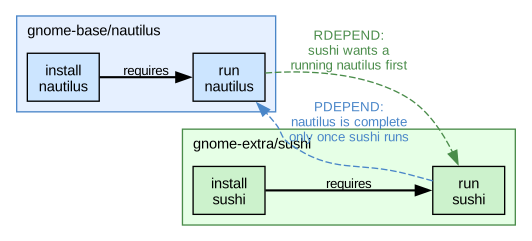
Solid arrows are hard requirements (a package runs only once it is
installed); dashed arrows are the two wishes. Follow the dashed arrows
and you walk in a circle: run nautilus wants to come after run sushi,
which wants to come after run nautilus.
--optimize soft-requirements: honor as many preferences as possible
Under this strategy every preference is handed to the wave projection, which accepts them one by one and keeps each exactly when it closes no cycle against the hard requirements and the preferences already accepted. In the loop above the first wish it meets is granted; the second would close the loop and is dropped — silently and safely, matching how Portage treats runtime cycles as freely orderable.
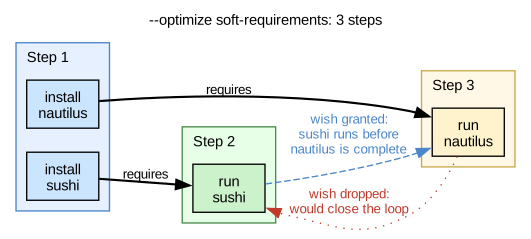
The plan is three steps long: both installs, then Sushi's run, then
Nautilus' run. One of the two wishes has been honored; which one depends
on the order in which the projection happened to visit them. Larger
loops pay more: with n packages preferring each other in a circle, the
projection keeps n − 1 preferences and lines the members up one per
step — a staircase
of single-package steps in the Gantt chart. The listing is close to the
linear order traditional emerge prints, which is what this strategy is
for: a familiar-looking plan, and the most individual runtime orderings
honored.
--optimize parallelism (default): a preference on a loop is void
Under the default strategy the decision is made in the rules, before the projection sees anything. A preference from H for D is void when H and D are mutually reachable — each depends on the other, directly or through other steps, counting hard requirements and preferences alike. Inside such a loop no order is better than another (there is nothing for the preferences to agree on), so all of them are void and only the hard requirements shape the plan; preferences between packages that are not on a common loop are kept, every one of them.
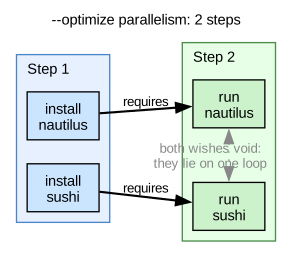
The same two packages now take two steps: both installs side by side,
then both runs side by side. For a loop of n packages the saving is
proportionally larger — the 22-package runtime loop under
app-xemacs/xemacs-devel planned as 47 steps under soft-requirements
and as 19 under parallelism; dev-ruby/dalli's gem loop went from 85
to 21. Because a preference is void or kept on the basis of the graph
alone, the outcome does not depend on visiting order, and the set of
preferences that reaches the projection is acyclic by construction: the
projection becomes a pure evaluator and its cycle branch is never taken.
The cost is the soft requirement itself. On the Nautilus/Sushi loop the
soft-requirements plan did get Sushi in before Nautilus was declared
complete; the parallelism plan makes no such attempt. For runtime
dependencies this is harmless — the files are on disk either way, and
nothing in the loop is built against anything else in it — but it is a
real difference, which is why both strategies exist.
Hard requirements are never traded away
Not every loop is made of wishes. media-sound/audacious PDEPENDs on
media-plugins/audacious-plugins (a wish: the player is complete once
its plugins are in), while the plugins DEPEND on the player (a hard
requirement: they are built against it).
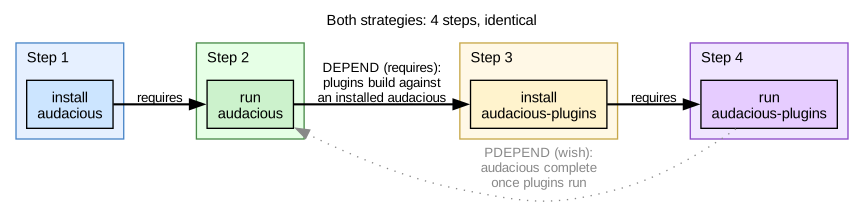
Here there is nothing to choose. The hard edge forces the player before
the plugins under both strategies; the PDEPEND wish is the only edge that
could give way, and it does — void under parallelism, dropped under
soft-requirements — for the same reason: it points back along a path
the hard edge already fixed. The plans are identical. The strategies
differ only where a loop consists of soft requirements alone.
Two consequences follow for anyone comparing plans across strategies:
- Plans never break. The hard requirements are the same edges under
both strategies;
parallelismonly ever withholds preferences. Every step in aparallelismplan is buildable when its wave is reached. - Loops are read off the declared edges. Mutual reachability is
computed over
requires∪ raw preferences before pass 2 bridges any hard cycle through the installed world (previous section). A preference that sits on a hard cycle the world later bridges is therefore void too; the hard edges of that cycle are still enforced.
Where the two strategies live in the code: the raw preferences are
ordering:prefers0/2; ordering:prefers/2 hands them on unchanged under
soft-requirements and filters them through ordering:same_component/2
under parallelism. The mutual-reachability classes come from a
generic, domain-free library predicate (components:classes/3 in
Source/Logic/components.pl), built once per ordering pass over all plan
steps and looked up by the rule — the ordering rules still contain no
graph algorithm, and the cost is linear in the size of the plan.
Within a wave, actions are finally reordered by merge-order bias: the actions other packages wait on most (highest reference count in the Triggers AVL) are listed first, so the builder starts the most-blocking work as early as possible.
Wave projection and plan output
The wave-list plan is a projection over the pass-2 proofs — an evaluator, not a decider. Every ordering decision was already made (and justified) during the proving pass; the projection merely assigns wave numbers by reading availability proofs:
- a step whose requirements are all world-bridged or assumption-bridged can start in wave 1;
- a step that cites earlier plan steps lands one wave after the last of them;
- accepted preferences raise a step's wave further, never lower it.
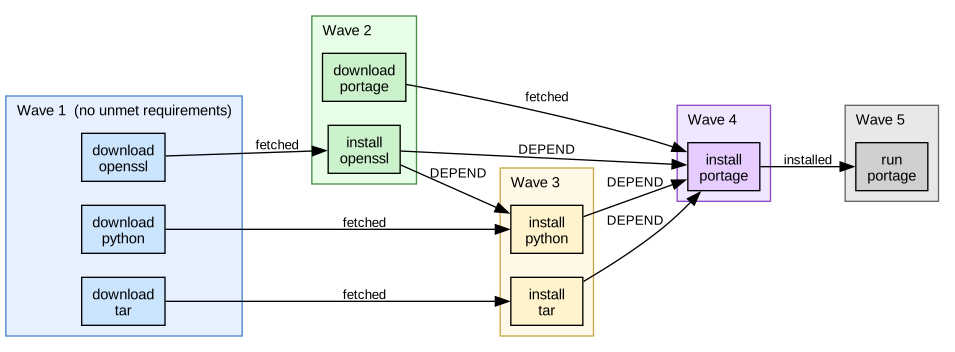
The output contract is unchanged from earlier releases: a list of waves, each containing full-format pass-1 rule terms. All actions within a wave are independent and can run concurrently. The printer renders the waves as numbered steps (Chapter 14); the builder executes them with real parallelism (Chapter 16). Neither consumer knows or cares that the waves are now backed by proofs.
The plan is annotated per entry with:
- Wave number — which parallel wave it belongs to
- Action — download, install, run, etc.
- Literal — the full
Repo://Entry:Action?{Context}term
The same laws order uninstalls
Depclean's uninstall order is the same three laws proved over a different
set of bindings (Source/Domain/Gentoo/Rules/unmerging.pl). A step is
the :unmerge of a removable package; what a step requires is the
release of every claim on it — each removable consumer must be unmerged
first; and the world provides nothing, because an installed consumer's
claim is a present fact in the VDB — there is no "already provided"
escape like merge ordering has.
Cyclic claim chains fall through the same currently_proving guard and
surface as retained-claim assumptions: the report names exactly which
package still depends on which at its unmerge point, instead of a bare
"cycle detected" flag. The wave projection is reused unchanged, and the
flattened waves are the uninstall order (consumers first, dependencies
last). Kahn's topological sort — the last procedural survivor of the
pre-proof planner — was retired with this pass.
One binding detail is load-bearing: the claim index reads the VDB
dependency models through the query layer, whose inlined model
construction dispatches through the active rule module. The index is
therefore prepared eagerly, before the unmerge prove scopes the rule
module to unmerging (see unmerging:with_unmerge_pass/2).
Further reading
- Chapter 8: The Prover — how the Proof AVL is constructed
- Chapter 9: Prover Assumptions — pass-1 cycle breaking
- Chapter 11: Rules and Domain Logic — how rule modules plug into the prover
- Chapter 12: Resolution — Configuration as Proofs — pass 1: the configuration being ordered
- Chapter 14: Output and Visualization — how the plan is rendered
- Chapter 16: Building and Execution — how the plan is executed
- Chapter 24: Dependency Ordering — PMS ordering semantics