Contextual Logic Programming
context is an object-oriented programming paradigm for Prolog, implemented in
Source/Logic/context.pl. It provides contexts (namespaces),
classes, and instances with public, protected, and private access control,
multiple inheritance, cloning, and declarative static typing of data members.
Motivation
Standard Prolog uses a flat global namespace. As applications grow, name collisions, uncontrolled access to dynamic predicates, and lack of modularity become obstacles. context addresses this by splitting the global namespace into isolated contexts, each with their own facts and rules.
The key insight is that contexts can be unified and can serve as feature terms describing software configurations — directly connecting to Zeller's Unified Versioning through Feature Logic. This makes context both a software engineering tool and a formal foundation for reasoning about configurations.
In practical terms, this is how portage-ng can treat a Portage tree, an overlay, and a VDB as separate objects that share the same interface but carry independent state — and how dependency contexts can be merged, intersected, and propagated through the proof tree.
How it differs from Logtalk
The syntax is comparable to Logtalk, but the approach is fundamentally different:
| Logtalk | context | |
|---|---|---|
| Approach | Compile-time translation to plain Prolog | Runtime generation of guarded predicates |
| Overhead | Source-to-source compilation step | No compilation; contexts created dynamically |
| Thread safety | Varies by backend | Built-in; tokens are thread-local |
| Feature unification | Not supported | Contexts unify as feature terms |
Because context works at runtime, contexts can be created, cloned, and composed dynamically — which portage-ng uses extensively to represent repositories, ebuilds, and configurations as live objects.
Core concepts
Contexts
A context groups together clauses of a Prolog application. By default, clauses are local to their context and invisible to other contexts unless explicitly exported. Referencing a context is enough to create it (creation ex nihilo).
Context rules are evaluated in the context in which they are defined. An exception are clauses declared as "transparent", which inherit their context from the predicate that is calling them — the same mechanism SWI-Prolog uses for meta-predicates, but applied at the context level.
Classes
A class is a special context that declares public, protected, and private meta-predicates. These declarations control access at three levels:
- Instantiation — which predicates are copied into the instance and how they are guarded.
- Inheritance — which predicates are visible to subclasses. Private predicates are not inherited; public and protected ones are.
- Invocation — which predicates external callers may use.
Only public predicates can be called from outside; protected and
private predicates throw a
permission_errorif accessed without a valid access token.
A class is declared with :- class. (or :- class([Parent1, Parent2])
for multiple inheritance). Predicate visibility is declared with
:- dpublic(name/1)., :- dprotected(age/1)., and
:- dprivate(secret/1).
Instances
Instances are dynamically created from a class via newinstance/1.
The creation process has four stages:
- Metadata registration — the instance is marked as
type(instance(Parent))in its$__metastore. - Predicate inheritance — all declared predicates from the parent class are copied. Each predicate is wrapped in a guard that checks an access token before execution.
- Freeze — the generated predicates are compiled via
compile_predicates/1for optimal performance (no more interpretation overhead). - Constructor call — if the class declares a constructor
predicate (same name as the class), it is called with the
arguments passed to
newinstance/1.
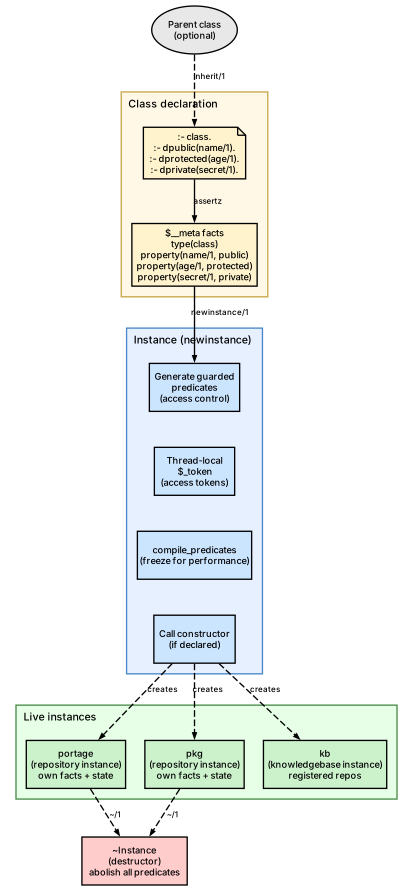
Each instance is a fully independent Prolog module with its own
dynamic facts. Multiple instances of the same class coexist
without interference — for example, portage and overlay are
both instances of the repository class, but each carries its own
cached ebuilds, location paths, and sync state.
Destruction
An instance is destroyed by calling ~Instance. The destructor
(if declared) runs first, then all dynamic predicates in the
instance module are abolished. Static contexts (built-in Prolog
modules) cannot be destroyed — attempting to do so raises a
permission_error.
Access control and thread safety
The access control mechanism uses thread-local tokens. When an
external caller invokes a public predicate on an instance, the
system asserts a $_token(thread_access) fact in the instance's
module. The guarded implementations of protected and private
predicates check for this token:
- Public — the token is asserted before the call and retracted
afterwards (via
call_cleanup). Any code called during the public predicate's execution can access protected and private predicates because the token exists. - Protected — the guard checks that the token exists. If it
does (i.e. the call originates from a public predicate on the
same instance), execution proceeds. Otherwise, a
permission_erroris thrown. - Private — same check as protected. The difference is conceptual: private predicates are not inherited by subclasses, while protected ones are.
- Static — the call is forwarded to the parent class directly, bypassing the instance.
Because the token is thread_local, concurrent threads can call
public predicates on the same instance without interfering with
each other's access grants.
Operators
context defines several operators for interacting with contexts. The diagram below shows how they relate to an instance's internal structure:
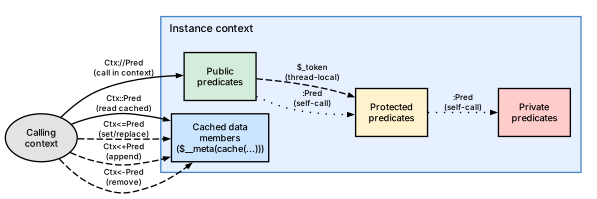
| Operator | Meaning |
|---|---|
Head ::- Body |
Declare a method clause (the contextual :-) |
:Pred |
Call Pred in the current context (self-call) |
::Pred |
Read a cached data member |
<=Pred |
Set a data member (evaluate, retract old, assert new) |
<+Pred |
Add a data member (evaluate, assert if not exists) |
<-Pred |
Remove a data member |
Ctx://Pred |
Call Pred in a specific context |
The ::- operator is declared at priority 1200 xfx — exactly the
priority of Prolog's :-. A clause Head ::- Body is an ordinary
logical rule, but one whose visibility and state are governed by the
instance it lives in: at instantiation it is copied into the instance
and wrapped in an access guard (see Instances above). The operator
doubles as the portage-ng logo;
Chapter 1, section 1.4.6 tells that story.
Data members
The ::, <=, <+, and <- operators implement data-member-like
behaviour. Under the hood, they work with $__meta(cache(...))
facts:
Ctx::Pred— looks upcache(Pred)in the instance's metadata. If found, calls the predicate (which succeeds immediately because the cached value has already been evaluated). This is a read operation.Ctx<=Pred— evaluatesPredin the instance, retracts any existing cache for the same functor/arity, and asserts the new result. This is a write-replace operation.Ctx<+Pred— evaluatesPredand asserts the result as a new cache entry without removing existing ones. This is an append operation, useful for multi-valued data members.Ctx<-Pred— retracts all cache entries matchingPred. This is a delete operation.
The :// operator
The :// operator is the primary way to call a predicate in
another context. It is defined simply as
'://'(Context, Predicate) :- Context:Predicate. — a thin
wrapper that resolves the context module and dispatches the call.
This operator appears throughout portage-ng in forms like
portage://entry(E) or kb://query(Q, R).
Example: a Person class
A complete worked example of a context class — including a
constructor, destructor, public/protected/private members, and
instance creation — is presented in
Chapter 1, section 1.4.6. The example
defines a person class with name and age accessors, title
management, and demonstrates how instances carry their own state
independently.
How portage-ng uses context
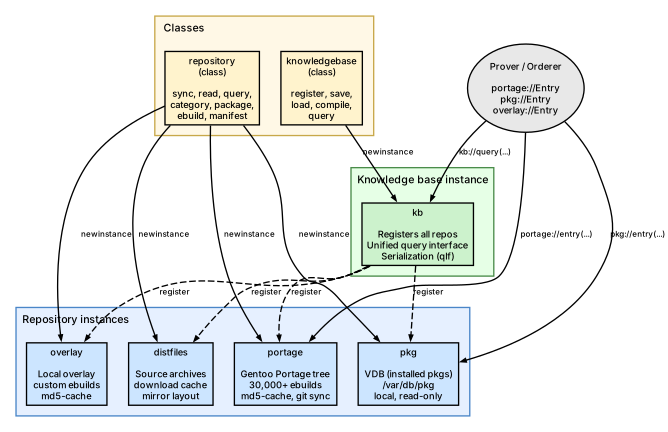
portage-ng uses context throughout its architecture. The
diagram below shows the two main classes (repository and
knowledgebase), their instances, and how the prover accesses them.
Repository instances
The repository class (Source/Knowledge/repository.pl) declares
a rich public interface for working with package repositories:
syncing from remote sources, reading metadata, querying entries,
and generating graphs. Protected members hold configuration
(location, cache path, remote URL, sync protocol).
Each repository on disk becomes a named instance:
portage— the main Gentoo Portage tree (30,000+ ebuilds), synced via git, with md5-cache metadata.pkg— the VDB (installed packages) at/var/db/pkg, a local read-only repository.overlay— a local overlay with custom ebuilds.distfiles— the source archive download cache.
Instance creation and configuration happens in the host-specific
config file (e.g. Source/Config/mac-pro.local.pl):
:- portage:newinstance(repository).
:- portage:init('/Volumes/Storage/Repository/portage-git',
                '/Volumes/Storage/Repository/portage-git/metadata/md5-cache',
                'https://github.com/gentoo/gentoo.git',
                'git', 'eapi').

:- pkg:newinstance(repository).
:- pkg:init('/Volumes/Storage/Repository/pkg', '', '', 'local', 'vdb').
Because all instances share the same class, the prover does not
need to know whether a dependency comes from the main tree, an
overlay, or the VDB — the same Repo://entry(E) call works for
all of them.
Knowledge base instance
The knowledgebase class (Source/Knowledge/knowledgebase.pl)
acts as a registry. Its register/1 predicate adds repository
instances, and its query/2 predicate searches across all
registered repositories. The instance kb is created at startup
and populated by the configuration file.
In client mode, the knowledge base instance is created with a
hostname and port: kb:newinstance(knowledgebase(Host, Port)).
This switches the instance into proxy mode, where queries are
forwarded to the remote server via Pengine RPC — but the calling
code sees the same kb://query(Q, R) interface as in standalone
mode.
Context terms in the prover
Beyond the OOP use, the context system's unification semantics
flow into the prover. Every literal in the proof tree carries a
context list ?{[...]} that accumulates constraints as the proof
deepens. These context terms are merged via feature unification —
the same algebraic operation that the context system uses for its
data members. This connection is explored in detail in
Chapter 22: Context Terms and Feature Unification.
Serialization
Context instances support serialization through the knowledge
base's save and load predicates. When kb://save is called,
the cached facts from all registered repository instances are
written to a QLF file (Knowledge/kb.qlf). On the next startup,
kb://load reads the compiled file back, restoring all repository
instances to their previous state without re-parsing the Portage
tree from disk. This is what makes portage-ng's startup fast —
the full knowledge base (30,000+ ebuilds with all metadata) loads
from the QLF file in under a second.
Further reading
- A. Zeller, Unified Versioning through Feature Logic, 1997
Source/Logic/context.pl— full implementationDocumentation/Handbook/22-doc-context-terms.md— how context terms flow through the prover