Context Terms in portage-ng
How contexts are created, propagated, and merged across the dependency graph.
Overview
Every literal in the prover carries a context — a list of tagged terms that records provenance, ordering, constraints, and USE requirements as the proof expands through dependencies. The literal format is:
Literal:Action?{Context}Contexts are not opaque blobs; they are structured as feature-term lists and are merged using a Zeller-inspired feature-unification algorithm. This gives them lattice semantics: merging two contexts produces a well-defined meet that preserves all non-contradictory information from both sides.
Anatomy of a context
A context is a Prolog list. Each element is either a plain term or a
Feature:Value pair. The distinction matters for merging:
| Form | Example | Merge behaviour |
|---|---|---|
| Plain term | self(R://E) |
Identity match; duplicates dropped |
| Feature:Value | build_with_use:use_state(En,Dis) |
Value-merged by val_hook/3 |
| Feature:Compound | slot(C,N,Ss):{...} |
Compound feature key |
For example, self(portage://sys-apps/portage-3.0.77-r3) is a plain
term that identifies the parent ebuild.
build_with_use:use_state([foo],[bar]) is a Feature:Value pair whose
value is merged when two contexts meet.
slot(sys-apps,portage,0/0):{Candidate} is a compound feature key
used for sub-slot rebuild tracking.
Common context tags
The following tags appear most frequently in proof-term contexts. Each tag is a Prolog term added to the context list during rule evaluation.
self(Repo://Entry) — set by dependency:add_self_to_dep_contexts.
Identifies the parent ebuild that introduced this dependency edge.
build_with_use:use_state(En,Dis) — set by
dependency:process_build_with_use. Carries bracketed USE
constraints from the dependency atom (e.g. dev-libs/foo[bar,-baz]).
slot(C,N,Ss):{Candidate} — set by dependency:process_slot.
Records a slot lock from := (subslot rebuild) semantics.
after(Literal) — seeded at world-set anchors
(world(Arg):register?{[after(Repo://Ebuild:run)]}) and propagated
into dependency contexts by featureterm:add_after_to_dep_contexts.
Ordering hint: this subtree should come after Literal in the plan.
Propagates to children.
after_only(Literal) — injected on PDEPEND edges (via
featureterm:add_after_only_to_dep_contexts). Becomes an
order_after preference (soft requirement) honored by the pass-2 orderer; does
not propagate to children.
replaces(pkg://Entry) — set by install/update rules. Records
which installed package this action replaces.
assumption_reason(Reason) — set by the domain assumption
fallback. Records why a domain assumption was made (e.g. missing,
masked, keyword_filtered).
suggestion(Type[, Detail...]) — set by the relaxation fallback.
Records an actionable suggestion; arity varies with the suggestion
type (e.g. suggestion(unmask), suggestion(accept_keyword, Kw),
suggestion(use_change, Ebuild, Changes)).
domain_reason(cn_domain(C,N,Tags)) — set by
cnselect:add_domain_reason_context/5. Diagnostic tags for version
domain narrowing.
constraint(cn_domain(C,N,Slot):{Domain}) — set by the constraint
system. Carries an inline per-slot constraint for domain scoping.
Context lifecycle
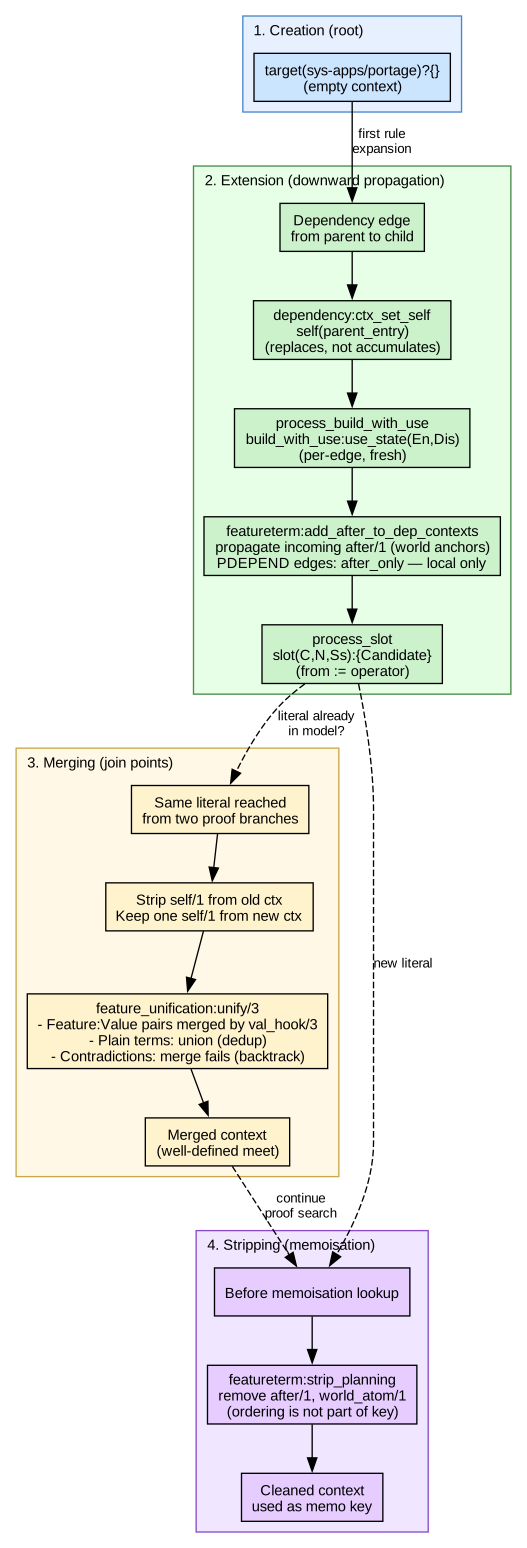
1. Creation (root)
At the top level, the prover starts with an empty context ({} or []).
The first rule expansion — typically target/2 → install — begins
populating it.
2. Extension (downward propagation)
As rules expand dependencies, contexts grow:
target(sys-apps/portage)?{}
  └─ install(portage://sys-apps/portage-3.0.77-r3):install?{...}
       ├─ dep(dev-lang/python):install?{self(portage://sys-apps/portage-3.0.77-r3),
       │                                 build_with_use:use_state([ssl,threads],[])}
       │    └─ dep(dev-libs/openssl):install?{self(portage://dev-lang/python-3.13),
       │                                       build_with_use:use_state([],[])}
       └─ dep(app-arch/tar):install?{self(portage://sys-apps/portage-3.0.77-r3)}
(Had the goal been seeded from a world-set anchor —
world(Arg):register?{[after(Repo://Ebuild:run)]} — an after/1
marker would additionally flow down every dependency edge.)
Key propagation rules:
self/1is set to the current ebuild at each dependency edge. It does not accumulate — each edge replaces the previousself.build_with_useis per-edge: the child gets a freshbuild_with_usefrom its dep atom, not the parent'sbuild_with_use.after/1propagates transitively (children inherit it).after_only/1does not propagate (ordering is local to this edge).assumption_reasonandbuild_with_useare dropped on PDEPEND edges (viafeatureterm:drop_build_with_use_and_assumption_reason/2).
3. Merging (join points)
When the prover encounters a literal that was already proven with a different context, it merges the old and new contexts via feature term unification:
sampler:ctx_union(OldCtx, NewCtx, MergedCtx)The merge algorithm:
- Strip
self/1from the old context entirely. - Extract one
self/1from the new context (keep it aside). - Unify the remaining lists via
feature_unification:unify/3. - Prepend the extracted
self/1back onto the result.
This guarantees:
- At most one
self/1in the merged result (from the new/incoming side). - Feature:Value pairs with the same key are merged by
val_hook/3. - Plain terms present in either side appear in the result (union semantics).
4. Stripping for memoisation
Before checking whether a literal has already been proven, planning markers are stripped so they don't pollute the memoisation key:
featureterm:strip_planning(Context0, Context)This removes after/1 and world_atom/1 — ordering and planning concerns
that should not affect whether a proof is reusable.
Feature unification in detail
feature_unification:unify/3 implements a horizontal unification
algorithm inspired by Zeller's feature logic:
- Normalise both terms (
{}→[]). - Walk both lists. For each
Feature:Valuepair in list A, check if list B has the sameFeature. - If both sides have
Feature, merge values viaval/3(orval_hook/3for domain-specific merge). - If only one side has
Feature, include it in the result. - Plain terms are matched by identity; duplicates are dropped.
Value merge rules
| V1 | V2 | Result | Semantics |
|---|---|---|---|
{L1} |
{L2} |
{Intersection} |
Set intersection (must be non-empty) |
[L1] |
[L2] |
[Union] |
Sorted union (fails on contradictions) |
atom V |
{L} |
{V} if V ∈ L |
Singleton intersection |
V |
V |
V |
Identity |
Domain-specific hooks (val_hook/3)
| Feature | Hook in | Merge behaviour |
|---|---|---|
build_with_use |
use.pl |
use_state(En1,Dis1) ⊔ use_state(En2,Dis2) = union of enable/disable sets; fails if a flag appears in both enable and disable |
cn_domain |
version.pl |
version_domain meet (intersection of version bounds); none is identity |
self/1 — parent provenance
The self/1 tag identifies which ebuild introduced this dependency.
It is critical for:
- USE evaluation:
use:effective_use_in_context/3looks up the USE model of the ebuild inself/1to evaluate USE conditionals. - Blocker source:
candidate:make_blocker_constraint/5usesself/1to determine who is blocking whom. - Parent narrowing:
candidate:maybe_learn_parent_narrowing/4usesself/1to learn that the parent version should be excluded when a child dependency cannot be satisfied. - REQUIRED_USE:
query:with_required_use_validate/3annotates REQUIRED_USE terms with:validate?{[self(...)]}so the prover knows the ebuild context.
Invariant: at most one self/1
Without bounding, self/1 would stack along dependency chains:
[self(A), self(B), self(C), ...] ← unbounded growthThe system prevents this at two levels:
dependency:ctx_set_self/3replaces any existingself/1when setting a new parent.- Feature term unification (
ctx_union_raw/3) strips allself/1from the old context and keeps only one from the new context.
build_with_use — bracketed USE requirements
When a dependency atom carries USE requirements (e.g.
dev-lang/python[ssl,threads]), they are recorded as:
build_with_use:use_state([ssl, threads], [])The enable list contains flags that must be ON; the disable list contains flags that must be OFF.
Per-edge, not inherited
Each dependency edge computes its own build_with_use from the dep atom.
The parent's build_with_use is removed before computing the child's:
dependency:process_build_with_use(MergedUse, ContextDep, NewContext, ...)This prevents a grandparent's USE requirements from leaking to grandchildren.
Merge semantics
When feature term unification merges two contexts with build_with_use, the val_hook
in use.pl takes the union of enable sets and the union of disable
sets. If a flag appears in both enable and disable, the merge fails
(contradiction), forcing the prover to backtrack.
Post dependencies
On PDEPEND edges, build_with_use is dropped because PDEPEND dependencies
are resolved at runtime, not build time, so build-time USE constraints do
not apply.
Constraints vs contexts
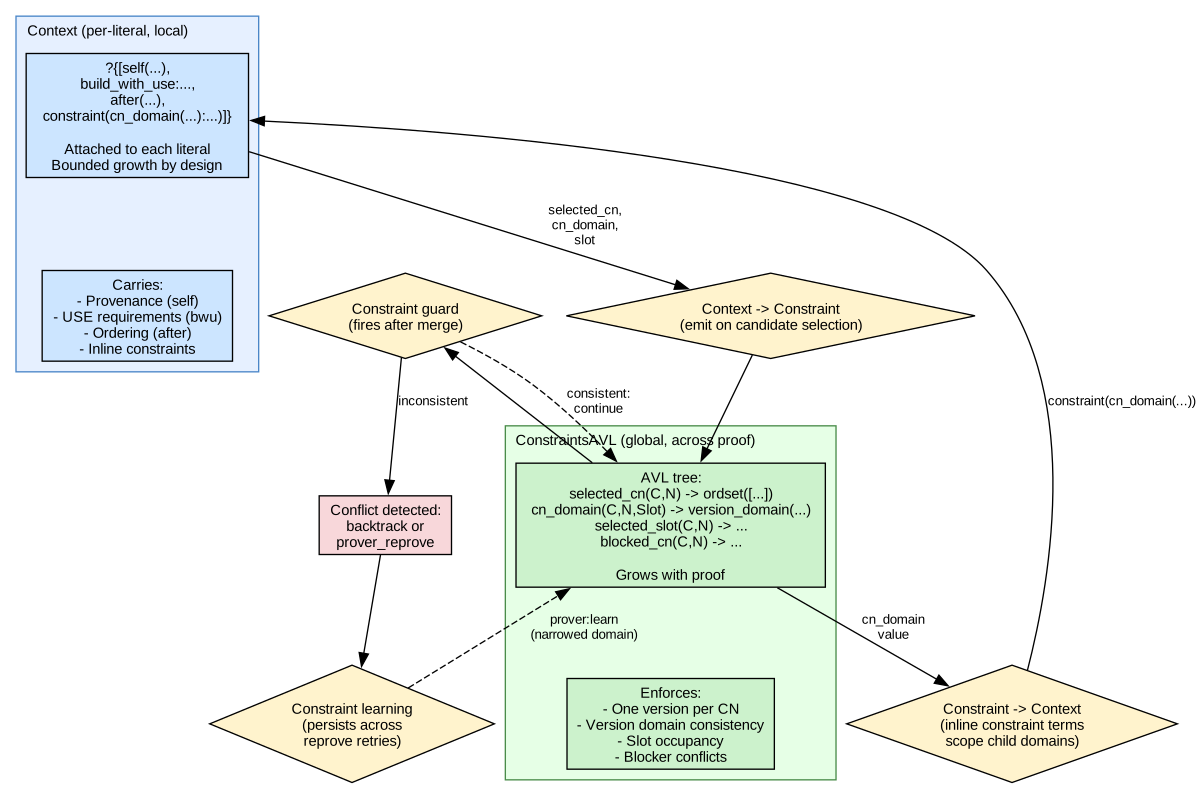
The proof system uses two complementary mechanisms for carrying
information, and it is easy to confuse them. Contexts are local:
each literal in the proof carries its own context list (?{...}),
recording where it came from, what USE flags were requested, and how
it should be ordered. Constraints are global: they live in a
shared ConstraintsAVL that spans the entire proof and track
cross-cutting invariants like "only one version of this package may
be selected" or "this package is blocked by another."
The table below summarises the key differences:
| Aspect | Context | Constraint |
|---|---|---|
| Scope | Per-literal (local) | Global (across proof) |
| Storage | List attached to ?{...} |
AVL in ConstraintsAVL |
| Growth | Bounded by design | Grows with proof |
| Purpose | Provenance, ordering, USE | Version selection, slot locks, blockers |
How they interact
Although contexts and constraints have different scopes, they are not isolated — information flows between them in both directions.
From context to constraint. When the rules layer selects a
candidate version for a dependency, it emits constraint terms into the
global ConstraintsAVL. For example, selecting dev-libs/openssl-3.1.4
produces a selected_cn(dev-libs, openssl) constraint and a
cn_domain constraint recording the version domain. These global
constraints ensure that if another dependency path also needs
dev-libs/openssl, the prover will detect any conflict.
From constraint to context. Sometimes a parent dependency wants
to narrow the version domain for a child before candidate selection
even begins. It does this by placing an inline constraint term like
constraint(cn_domain(C,N,Slot):{Domain}) directly in the context list.
When the child's rule fires, it reads this term and applies the
domain restriction.
Constraint guards. After each new constraint is merged into the
global store, heuristic:constraint_guard/2 fires to check consistency.
The guard verifies that version domains are compatible with selected
candidates, that each slot has at most one selected version, and that
no selected package is blocked by another.
Constraint learning. When a guard detects an inconsistency, it
can record a narrowed domain via prover:learn/3. This learned
constraint persists across reprove retries, preventing the prover
from repeating the same dead-end choice (see
Chapter 9 and
Chapter 10).
Ordering: after vs after_only
Both influence ordering in the plan, but they differ in origin and propagation:
| Marker | Propagates to child deps? | Origin / use case |
|---|---|---|
after(Lit) |
Yes | World-set anchors: the package and all its deps should come after Lit |
after_only(Lit) |
No | PDEPEND completion: only this package (not its deps) prefers to come after Lit |
In after_only mode the marker is rewritten to a
constraint(order_after(...):{[]}) term — an ordering-only
preference (a soft requirement; it travels through the constraint
store but is not a constraint on the model) that the pass-2 orderer
(prefers/2 in
Source/Domain/Gentoo/Rules/ordering.pl) honors when it lies on no loop
(the exact policy is the --optimize strategy, Chapter 13). Neither
marker is minted per DEPEND/RDEPEND edge;
build-time vs runtime ordering is decided in pass 2 by the ordering
rule set (requires/2 / prefers/2), not by context markers.
Extraction
featureterm:get_after_with_mode(Context, After, AfterForDeps, ContextRest)- If
after(X)→After = X,AfterForDeps = X(propagate). - If
after_only(X)→After = X,AfterForDeps = none(don't propagate). - If neither → both
none.
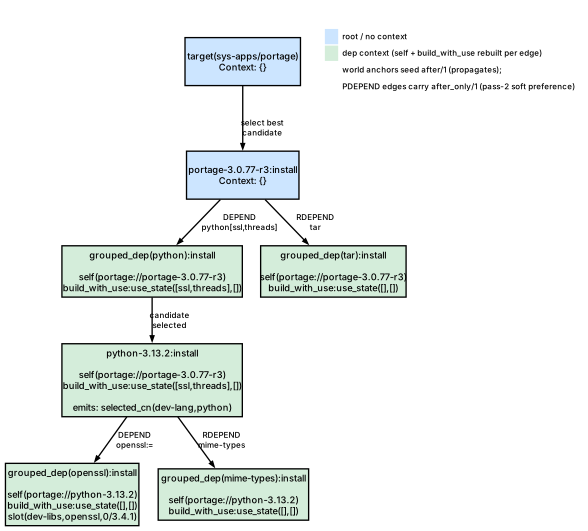
Example: full context evolution
The following example traces how context evolves as the prover walks
from a user target (sys-apps/portage) through two levels of
dependencies. The diagram shows the key context tags at each step.
Step 1 — Target resolution
The user runs emerge sys-apps/portage. The target rule selects the
best visible candidate (portage-3.0.77-r3). At this point the
context is empty — there is no parent, no USE requirement, and no
ordering marker.
Step 2 — Expanding portage's dependencies
The install rule for portage expands its DEPEND and RDEPEND. Each dependency atom gets its own context, built from three operations:
add_self_to_dep_contextsaddsself(portage://portage-3.0.77-r3)to record that portage is the parent.process_build_with_usetranslates bracketed USE flags from the atom. Fordev-lang/python[ssl,threads], this producesbuild_with_use:use_state([ssl,threads],[]). Forapp-arch/tar(no brackets), the USE state is empty.featureterm:get_after_with_mode+featureterm:add_after_to_dep_contextspropagate any incomingafter/1marker (e.g. from an@worldanchor) into the dep contexts. No new markers are minted here — DEPEND and RDEPEND atoms are treated alike; their relative ordering is a pass-2 concern.
Step 3 — Resolving python
The candidate python-3.13.2 is selected. A selected_cn constraint
is emitted into the global ConstraintsAVL (not the context). The
context itself is passed down unchanged from the grouped dependency.
Step 4 — Expanding python's dependencies
Python's own dependencies get fresh contexts. Notice how each tag is rebuilt at this level:
selfnow points topython-3.13.2, not to portage. Theselftag always records the immediate parent, never accumulates.build_with_useis replaced based on the new atom.dev-libs/openssl:=has no bracketed flags, so the USE state becomes empty.after— if anafter/1marker arrived with the incoming context (e.g. the target was an@worldanchor), it is propagated onward into python's dep contexts.- Slot lock — the
:=operator ondev-libs/openssl:=adds aslot(dev-libs,openssl,0/3.4.1)tag to the context, recording the sub-slot for rebuild tracking. after_only— had python carried a PDEPEND, that edge would getafter_only(python:install), later rewritten to anorder_afterpreference that does not propagate to the child's own deps.
Key observations
self/1always points to the immediate parent, never accumulates along the chain.build_with_useis replaced at each edge based on the dependency atom's bracketed flags.after/1(from world-set anchors) propagates down the tree;after_only/1(from PDEPEND edges) does not. DEPEND-vs-RDEPEND ordering is decided in pass 2, not by context markers.- Slot locks (
:=) addslot/3entries to the context. - Constraint emissions (e.g.
selected_cn) go into the global ConstraintsAVL, not into the context.
Design rationale
Why feature unification?
Traditional dependency solvers use flat constraint lists or SAT clauses. portage-ng uses feature-term unification because:
- Composability: Contexts from different proof branches merge naturally at join points without ad-hoc conflict resolution.
- Bounded growth: The
self/1stripping in feature term unification and the per-edgebuild_with_usereplacement prevent unbounded context growth along dependency chains. - Domain extensibility: New context tags can be added without changing
the merge infrastructure — just add a
val_hook/3clause if domain-specific merge is needed. - Conflict detection: The merge fails (backtracks) on contradictions (e.g. a flag in both enable and disable), providing natural constraint propagation.
Why separate contexts and constraints?
Contexts are local (per-literal, scoped to a proof branch) while constraints are global (shared across the entire proof). This separation allows:
- Contexts to carry provenance information that should not leak across unrelated proof branches.
- Constraints to enforce global invariants (e.g. only one version of a package can be selected) that must hold across the entire proof.
- Constraint learning to persist across reprove retries, narrowing the search space incrementally.