Dependency Ordering
When a package manager installs several packages at once, the order in which they are merged matters. A compiler must be installed before the packages that need it for building; a shared library must be present before the programs that link against it can run. The Gentoo Package Manager Specification (PMS) defines five dependency types, each with different ordering strength. Portage, Paludis, and portage-ng all interpret these types, but they differ in how strictly they enforce ordering — especially when cycles make a perfect order impossible.
Dependency types
The PMS (Chapter 8) groups dependencies into five classes based on when the dependency must be available.
DEPEND / BDEPEND — build-time dependencies. These must be installed and usable before
pkg_setupruns and throughout thesrc_*build phases. BDEPEND (introduced in EAPI 7) targets the build host (CBUILD), while DEPEND targets the target host (CHOST). Both create hard requirements: the dependency must be merged before the dependent can be built.RDEPEND — runtime dependencies. These must be installed before the package is "treated as usable." This is a soft requirement — a preference: ideally satisfied before the dependent is merged, but it may give way when cycles exist.
PDEPEND — post-dependencies. These only need to be installed "before the package manager finishes the batch." This is the weakest constraint — there is no requirement that the post-dependency is merged before the dependent.
IDEPEND — install-time dependencies (EAPI 8+). Needed during
pkg_preinstandpkg_postinst. Treated similarly to runtime dependencies for ordering purposes.
Phase functions and dependency availability
Different ebuild phases have access to different dependency classes:
Build phases (src_unpack through src_install)
: DEPEND, BDEPEND
Install phases (pkg_preinst, pkg_postinst, pkg_prerm, pkg_postrm)
: RDEPEND, IDEPEND
Configuration (pkg_config)
: RDEPEND, PDEPEND
Portage's approach
Portage builds a single dependency graph where every package is a node and every dependency creates a directed edge. Each edge carries a priority that records how binding the edge is:
| Dependency | Priority | Breakable? |
|---|---|---|
| DEPEND / BDEPEND | buildtime (highest) | Never |
RDEPEND with := slot op |
runtime_slot_op | Only when cross-compiling |
| RDEPEND | runtime | Yes, for cycles |
| PDEPEND | runtime_post (lowest) | Yes, first to break |
Progressive relaxation
When Portage runs its topological sort and cannot find a leaf node (a package with no unsatisfied dependencies), it progressively drops weaker edges until a leaf appears. The relaxation proceeds in four passes:
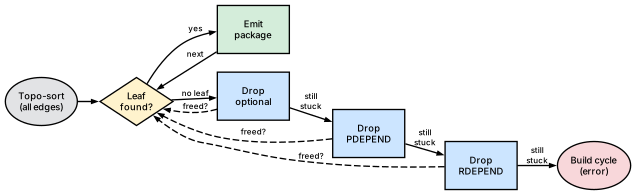
- All edges respected — standard topological sort.
- Drop optional edges — removes edges for optional dependencies.
- Drop PDEPEND edges — the weakest real dependency type is discarded.
- Drop RDEPEND edges — runtime edges are relaxed, freeing most remaining cycles.
If no leaf is found even after dropping RDEPEND edges, the remaining cycle involves only build-time dependencies. This is a hard error — Portage cannot resolve it and reports the cycle to the user.
What this means in practice
In the common (acyclic) case, Portage merges all dependencies — including RDEPEND — before the packages that need them. When cycles exist, PDEPEND edges are broken first, then RDEPEND edges. Build-time edges are never broken.
Paludis's approach
Paludis takes a different view. It builds a Node-Adjacency Graph
(NAG) where edges carry two boolean flags: build() for build-time
dependencies and run() for runtime dependencies. Notably, PDEPEND
creates no edge at all. The Paludis source comments explain the
reasoning: most post-dependencies already depend on the thing
requiring them anyway, so adding a backwards edge would just create
unnecessary cycles.
SCC-based cycle handling
Rather than relaxing edges progressively, Paludis uses Tarjan's algorithm to find strongly connected components (SCCs) and then classifies each one:
- Single-node SCC — no cycle, scheduled directly.
- Runtime-only SCC (no build edges) — ordered arbitrarily. Paludis treats runtime-only cycles as having no ordering significance at all.
- Build-dep SCC — Paludis tries to break the cycle by removing
edges whose dependencies are already satisfied (
build_all_metorrun_all_met). If the SCC is still cyclic after that, it is marked as unorderable.
The key insight from Paludis is stronger than Portage's progressive relaxation: runtime-only cycles are not just breakable — they are free to order however is convenient.
portage-ng's approach
portage-ng models dependencies as a two-phase proof tree. Each
package has an :install action (building) and a :run action
(being usable). The different dependency types map naturally onto
this structure.
Intra-group dependency ordering
Before proving the dependencies within a single package,
ranking:dep_priority/2 sorts them by constraint tightness.
Tightly constrained dependencies are proved first so that their
selected_cn locks early, preventing greedy conflicts where an
unconstrained sibling picks a version that later clashes. The
priority ladder (lower = proved first): tight upper bound (1) →
tilde (4) → wildcard (8) → unconstrained (999). Within each tier,
slot specificity further refines the order. See
Chapter 12 for details.
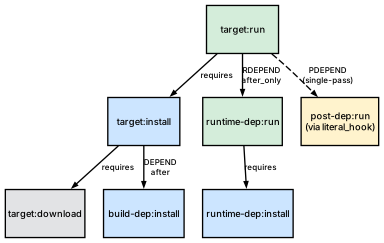
- DEPEND / BDEPEND create edges to
:installactions withafter()context tags that propagate down the dependency chain. These are hard requirements (requires/2in the ordering bindings). - RDEPEND create edges to
:runactions withafter_only()context tags that stop at the immediate children. These are soft requirements — preferences (prefers/2). - PDEPEND are handled by the
heuristic:proof_obligation/4hook in a single pass during proof search, without creating explicit ordering edges in the proof.
When cycles appear, the ordering pass (Chapter 13) resolves them at
proof time: a requirement whose provider is still being scheduled falls
through to a citation of the installed world (VDB), or — when nothing
bridges the loop — to an honest unreachable assumption. Runtime-only
cycles never bind at all, because RDEPEND edges are preferences
(matching Paludis's insight) that are void or dropped when they lie on
a cycle (Chapter 13, --optimize).
PDEPEND completion ordering
Although PDEPEND creates no edge during proof search, a package P that
declares PDEPEND is only fully functional once its post-dependencies are
merged. If another package consumes P and starts building before P's
PDEPEND closure is installed, its build can fail (e.g. a Ruby extension's
extconf.rb hits a LoadError, or a CMake CMAKE_C_COMPILER check fails
because a toolchain component is not yet on PATH).
The ordering bindings close this gap with a completion preference
(ordering:prefers/2 in Source/Domain/Gentoo/Rules/ordering.pl): a consumer
whose dependency carries an order_after anchor on a PDEPEND provider
prefers the install heads of that provider's PDEPEND targets — i.e. it is
ordered after P's whole post-install group, matching emerge's behaviour
(portage-ng#18).
Because this is a preference, not a hard requirement, it is inherently
cycle-safe: under the default --optimize parallelism strategy a
preference whose two ends are mutually reachable is void in the rules
(ordering:same_component/2); under --optimize soft-requirements the
wave projection accepts each preference exactly when it closes no cycle
against the hard edges and the previously accepted preferences (Chapter
13, "Preferences: soft requirements"). A consumer that is itself a
member of the provider's PDEPEND group is therefore never bumped — the
preference back onto its own group lies on a loop and is void / dropped
silently (portage-ng#19).
Densely cyclic toolchain closures (e.g. LLVM) are safe for the same
reason: no preference can collapse the ordering of an acyclic chain
elsewhere in the plan (portage-ng#26).
A per-pass PDEPEND anchor index makes the preference lookup cheap; plans without any PDEPEND provider pay only an empty index probe.
How the three approaches compare
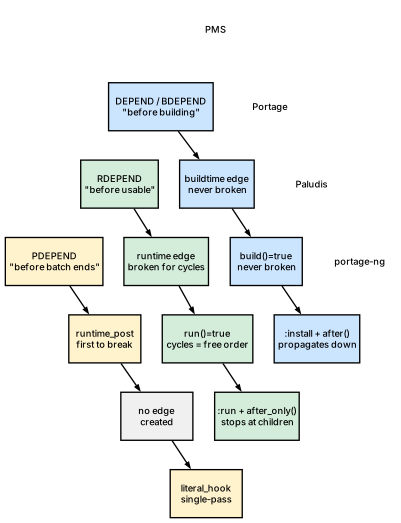
The diagram below traces how each PMS dependency type is implemented across the three resolvers. Blue indicates hard (build-time) requirements, green indicates soft (runtime) requirements — preferences — and yellow the weakest (post-dependency) edges.
| Aspect | Portage | Paludis | portage-ng |
|---|---|---|---|
| DEPEND/BDEPEND | Hard edge, never broken | Hard edge, never broken | :install + after(), hard |
| RDEPEND | Soft edge, broken for cycles | Soft edge, cycles freely ordered | :run + after_only(), soft |
| PDEPEND | Weak edge, first to break | No edge at all | proof obligation hook, no proof edge; completion preference in ordering pass |
| Cycle strategy | Progressive relaxation | SCC classification | World citation (VDB) or unreachable assumption |
| Build-time cycles | Error / merge group | Relax met edges, then error | Bridged by installed world; honest bootstrap boundary otherwise |
Annex: overlay test cases
portage-ng ships with a synthetic overlay (Repository/Overlay/) containing
80 test cases that exercise the resolver in isolation. Each test uses
tiny packages with carefully crafted dependency relationships, making it
easy to see exactly how the resolvers behave. The five cases below
illustrate the ordering concepts discussed in this chapter. For each
case we show the dependency graph, a short description, and the captured
output from both Portage (emerge -vp) and portage-ng (--pretend).
Annex A — Basic ordering (test01)
Four packages with a clean dependency chain: web depends on app,
db, and os; app depends on db and os; db depends on os.
No cycles, no special dependency types.
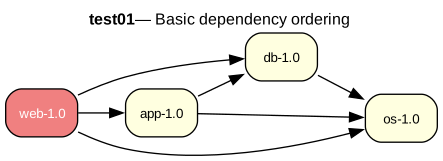
Both resolvers produce the same order: os first (no dependencies),
then db and app (whose dependencies are now satisfied), and finally
web. portage-ng additionally shows the two-phase :install /
:run structure and groups downloads into a parallel first step.
Portage output:
[ebuild  N     ] test01/os-1.0::overlay   0 KiB
[ebuild  N     ] test01/db-1.0::overlay   0 KiB
[ebuild  N     ] test01/app-1.0::overlay  0 KiB
[ebuild  N     ] test01/web-1.0::overlay  0 KiB

Total: 4 packages (4 new)
portage-ng output:
  step  1 | download  overlay://test01/web-1.0
          | download  overlay://test01/os-1.0
          | download  overlay://test01/db-1.0
          | download  overlay://test01/app-1.0

  step  2 | install   overlay://test01/os-1.0
  step  3 | run       overlay://test01/os-1.0
  step  4 | install   overlay://test01/db-1.0
  step  5 | run       overlay://test01/db-1.0
  step  6 | install   overlay://test01/app-1.0
  step  7 | run       overlay://test01/app-1.0
  step  8 | install   overlay://test01/web-1.0
  step  9 | run       overlay://test01/web-1.0

Total: 12 actions (4 downloads, 4 installs, 4 runs)Annex B — Transitive RDEPEND (test50)
app has a compile-time dependency on foo, and foo has a runtime
dependency on bar. The question is whether bar — a transitive
runtime dependency of a build dependency — appears in the merge plan.
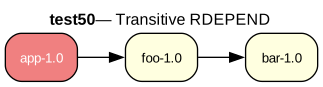
Both resolvers correctly include all three packages. The ordering is
bar first (so foo can run), then foo (so app can build), then
app.
Portage output:
[ebuild  N     ] test50/bar-1.0::overlay  0 KiB
[ebuild  N     ] test50/foo-1.0::overlay  0 KiB
[ebuild  N     ] test50/app-1.0::overlay  0 KiB

Total: 3 packages (3 new)
portage-ng output:
  step  1 | download  overlay://test50/foo-1.0
          | download  overlay://test50/bar-1.0
          | download  overlay://test50/app-1.0

  step  2 | install   overlay://test50/bar-1.0
  step  3 | run       overlay://test50/bar-1.0
  step  4 | install   overlay://test50/foo-1.0
  step  5 | install   overlay://test50/app-1.0
  step  6 | run       overlay://test50/app-1.0

Total: 8 actions (3 downloads, 3 installs, 2 runs)Annex C — Runtime cycle (test07)
Same four-package graph as Annex A, but os adds a runtime
dependency back on web, creating a cycle. The back-edge is an
RDEPEND, so both resolvers treat the cycle as benign.
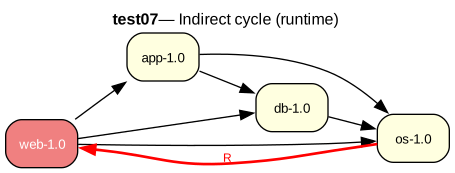
Portage reports the cycle as a warning but still produces a valid merge
list (using 1 backtrack). portage-ng classifies it as benign and
produces a clean plan with no assumptions — notice that web, app,
and db are installed in parallel in step 3 because the runtime cycle
makes their relative order irrelevant.
Portage output:
[ebuild  N     ] test07/web-1.0::overlay  0 KiB
[ebuild  N     ] test07/app-1.0::overlay  0 KiB
[ebuild  N     ] test07/db-1.0::overlay   0 KiB
[ebuild  N     ] test07/os-1.0::overlay   0 KiB

Total: 4 packages (4 new)

 * Error: circular dependencies:
(test07/os-1.0::overlay) depends on
 (test07/web-1.0::overlay) (runtime)
  (test07/os-1.0::overlay) (buildtime)
portage-ng output:
  step  1 | download  overlay://test07/web-1.0
          | download  overlay://test07/os-1.0
          | download  overlay://test07/db-1.0
          | download  overlay://test07/app-1.0

  step  2 | install   overlay://test07/os-1.0
  step  3 | install   overlay://test07/web-1.0
          | install   overlay://test07/app-1.0
          | install   overlay://test07/db-1.0
  step  4 | run       overlay://test07/web-1.0
          | run       overlay://test07/app-1.0
          | run       overlay://test07/db-1.0
  step  5 | run       overlay://test07/os-1.0

Total: 12 actions (4 downloads, 4 installs, 4 runs)Annex D — PDEPEND (test66)
app depends on lib (compile-time), and lib declares plugin as
a PDEPEND. The plugin should be resolved, but it does not need to be
installed before lib.
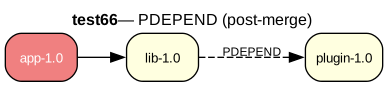
Portage merges plugin first (it has no hard dependencies), then lib,
then app. portage-ng installs lib and plugin in parallel in
step 2, since PDEPEND creates no ordering requirement between them here.
The plugin's :run action comes last, after the main target. (When a
package outside the PDEPEND closure consumes the provider, the
ordering pass's PDEPEND completion preference
additionally orders that consumer after the provider's post-install
group; this minimal test has no such external consumer.)
Portage output:
[ebuild  N     ] test66/plugin-1.0::overlay  0 KiB
[ebuild  N     ] test66/lib-1.0::overlay     0 KiB
[ebuild  N     ] test66/app-1.0::overlay     0 KiB

Total: 3 packages (3 new)
portage-ng output:
  step  1 | download  overlay://test66/plugin-1.0
          | download  overlay://test66/lib-1.0
          | download  overlay://test66/app-1.0

  step  2 | install   overlay://test66/lib-1.0
          | install   overlay://test66/plugin-1.0
  step  3 | run       overlay://test66/lib-1.0
  step  4 | install   overlay://test66/app-1.0
  step  5 | run       overlay://test66/app-1.0
  step  6 | run       overlay://test66/plugin-1.0

Total: 9 actions (3 downloads, 3 installs, 3 runs)Annex E — PDEPEND cycle (test79)
server has an RDEPEND on client, and client has a PDEPEND back
on server. This creates a cycle, but since PDEPEND creates no
ordering edge, the cycle is naturally broken.
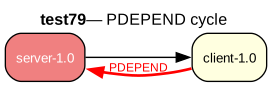
Portage handles this cleanly — the PDEPEND obligation is already
satisfied because server was merged as part of the same batch.
portage-ng's proof obligation mechanism resolves the PDEPEND
in a single pass with no assumptions needed.
Portage output:
[ebuild  N     ] test79/client-1.0::overlay  0 KiB
[ebuild  N     ] test79/server-1.0::overlay  0 KiB

Total: 2 packages (2 new)
portage-ng output:
  step  1 | download  overlay://test79/server-1.0
          | download  overlay://test79/client-1.0

  step  2 | install   overlay://test79/client-1.0
  step  3 | run       overlay://test79/client-1.0
  step  4 | install   overlay://test79/server-1.0
  step  5 | run       overlay://test79/server-1.0

Total: 6 actions (2 downloads, 2 installs, 2 runs)References
- PMS Chapter 8: https://projects.gentoo.org/pms/8/pms.html
- Portage source:
lib/_emerge/depgraph.py(method_serialize_tasks) - Portage priorities:
lib/_emerge/DepPriorityNormalRange.py - Paludis orderer:
paludis/resolver/orderer.cc - Paludis classifier:
paludis/resolver/labels_classifier.cc - Full overlay test suite:
Documentation/Tests/README.md(80 test cases)