Version Domains
Version domains are the mechanism by which portage-ng reasons about version
constraints. Every version comparison, every dependency operator (>=,
<=, ~, =*), and every learned constraint is expressed as an operation
on version domains.
Why version domains matter
Picture two packages that both pull in dev-libs/openssl, but with different
requirements. Package A depends on >=dev-libs/openssl-3.0: any OpenSSL from
3.0 upward is acceptable on that path. Package B depends on
<dev-libs/openssl-3.2: only versions strictly below 3.2 are acceptable
there. If both constraints apply to the same install, you are not looking for
a single magic number first — you are asking which versions lie in the overlap
of two sets. Versions that satisfy both are exactly those in 3.0 ≤ v < 3.2:
the half-open interval [3.0, 3.2).
That overlap is the intersection (in domain terms, the meet) of two version domains. Version domains represent sets of acceptable versions; combining constraints from different dependency paths means intersecting those sets until you obtain the tightest description still compatible with everything seen so far. The rest of this chapter spells out how those sets are stored, compared, and merged in code.
Version representation
Versions are stored as version/7 compound terms:
version(NumsNorm, Alpha, SuffixRank, SuffixNum, SuffixTail, Rev, Full)| Field | Example | Meaning |
|---|---|---|
NumsNorm |
[3,0,77] |
Normalized numeric components |
Alpha |
'' or 'a' |
Alpha suffix (empty atom if none) |
SuffixRank |
4 |
Numeric rank of first version suffix (_alpha=0, _beta=1, _pre=2, _rc=3, (final)=4, _p=5) |
SuffixNum |
0 |
First suffix number (e.g. 3 in _rc3) |
SuffixTail |
[] or [s(5,2),s(4,0)] |
Remaining suffixes as s(Rank, Num) pairs, closed by the s(4,0) "(final)" terminator ([] if the version has no suffix) |
Rev |
3 |
Revision number (from -r3) |
Full |
'3.0.77-r3' |
Original version string |
Empty or absent versions use the atom version_none.
Version comparison
Versions are compared using Prolog's standard compare/3 directly on the
compound term. No runtime key conversion is needed — the version/7
structure is designed so that standard term ordering produces correct PMS
version ordering:
compare(Order, version([3,0,77],...), version([3,1,0],...))
% Order = (<)
This works because:
NumsNormis a list of integers (lexicographic list comparison)SuffixRankmaps suffixes to integers in PMS orderSuffixTaillists remaining suffixes ass(Rank, Num)pairs ending in thes(4,0)"(final)" terminator, so multi-suffix versions compare pairwise per PMS (e.g.1_rc1_p2 > 1_rc1_pre1and1_rc1 > 1_rc1_pre1)Revis a plain integer
Version domain model
A version domain represents a set of acceptable versions for a package. It is stored as:
version_domain(Slots, Bounds)| Field | Type | Meaning |
|---|---|---|
Slots |
list or any |
Acceptable slots (or any for unconstrained) |
Bounds |
structured term | Version bounds (upper, lower, exact, wildcard) |
The none atom represents an unconstrained domain (all versions accepted).
Domain operations
Domain meet (intersection)
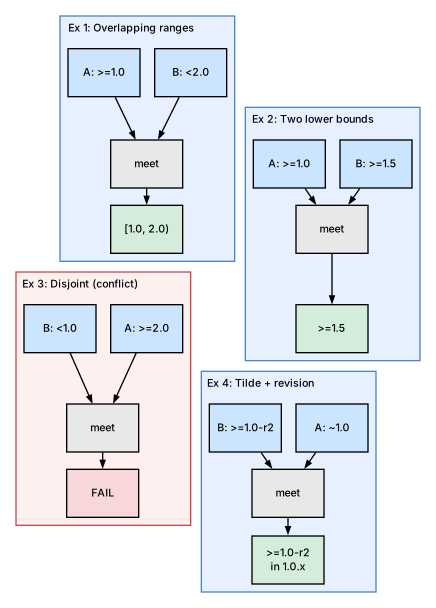
When two dependency paths impose different version constraints on the same package, the domains are intersected:
version_domain:domain_meet(Domain1, Domain2, Intersection)The intersection computes the tightest bounds that satisfy both constraints.
If the intersection is empty (no version satisfies both), the goal fails:
there is no Intersection term that stays consistent with the combined
bounds (and related checks such as slot compatibility).
Worked examples (meet in practice)
The following sketches use dependency-style wording; internally each side
becomes a version_domain/2 (or none) whose bounds are merged by
domain_meet/3. Intuitively, meet = AND over acceptable versions.
Example 1 — overlapping range.
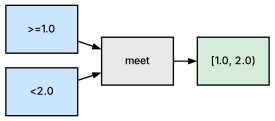
Lower bound >=1.0 and upper bound <2.0 describe the half-open interval
[1.0, 2.0). The meet is that interval: every version that satisfies both
operators is exactly a version at least 1.0 and strictly below 2.0.
Example 2 — two lower bounds.
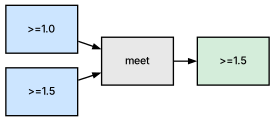
>=1.0 meets >=1.5. The stricter requirement wins: the intersection is
>=1.5. Anything below 1.5 was already ruled out by the second constraint.
Example 3 — disjoint constraints (conflict).
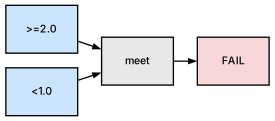
>=2.0 meets <1.0. No version can be simultaneously at least 2.0 and below
1.0. domain_meet/3 fails: the normalised domain is empty, and the prover
must treat this as an unsatisfiable combined requirement.
Example 4 — tilde vs revision-aware lower bound.
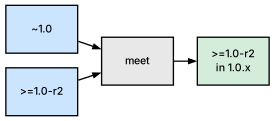
~1.0 (in PMS terms: same main version as 1.0, any revision) restricts
candidates to the 1.0 line. Meeting that with >=1.0-r2 keeps you on that
line but drops revisions below -r2: the effective set is >=1.0-r2 within
the 1.0.x family, not a broader branch of the package.
In all cases, when the meet succeeds, candidate selection and consistency checks use the narrower domain; when it fails, there is no shared non-empty set of versions to choose from.
Consistency check
version_domain:domain_inconsistent(Domain)Detects structurally empty domains — an empty slot set, conflicting
exact bounds, or a lower bound above an upper bound. The meet
operation rejects a result when this check succeeds
(\+ domain_inconsistent(...)); it is purely structural and never
consults the repository.
Feature logic intuition
In Zeller-style feature logic, a feature describes a set of objects that share certain properties — not necessarily a single object, but a well-bounded set described by those properties. A version domain is the same idea at the version level: it is a feature whose extension is the set of versions that satisfy given slot and bound constraints (above a threshold, below a threshold, exact match, tilde range, wildcard prefix, and so on).
Feature unification — meeting two features so that an object must satisfy
both — corresponds directly to domain intersection. This is not merely a
pedagogical analogy: portage-ng wires version domains into the generic
unification hook in feature_unification:val_hook/3, so that merging domain
values follows the same meet operation as version_domain:domain_meet/3.
A practical consequence is monotonic narrowing: along a resolution path, domains only become tighter (fewer acceptable versions), never wider, unless explicitly reset by a broader reprove strategy. Each successful refinement shrinks the search space; that is why successive reprove attempts can be viewed as making measurable progress toward either a concrete choice or a clear conflict.
Learned domain narrowing
The prover's learned constraint store uses version domains to carry narrowed version information across reprove retries. Each learned constraint is keyed by a category–name–slot triple:
cn_domain(Category, Name, Slot)Conflict detection and learning
When two dependency edges impose incompatible version requirements on the same package, the constraint guard detects an empty intersection and records a narrowed domain for future attempts.
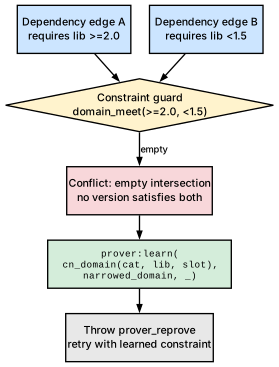
The guard calls domain_meet/3 on the two incoming domains. When the
result is empty (no version satisfies both), the guard stores the
narrowed domain via prover:learn/3 and throws prover_reprove to
restart the proof with this new knowledge.
Applying learned domains on reprove
On the next reprove attempt, grouped_dep_effective_domain intersects
the learned domain with the local domain coming from the current proof
context, before candidate selection begins.
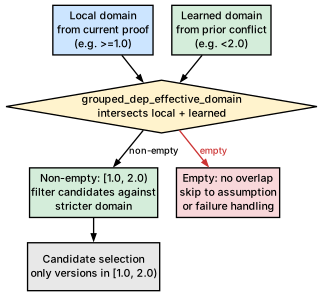
If the intersection is non-empty, candidates are filtered against the stricter combined domain — avoiding the same dead-end choice that caused the previous conflict. If the intersection is empty, there is no compatible overlap left: the prover can skip directly to assumption or failure handling instead of selecting candidates from an empty domain.
Chapter 9 walks through the reprove and learning mechanics in full; Chapter 12 ties domains into resolve-time rule evaluation and candidate generation.
Wildcard domain learning
When a wildcard dependency like =dev-python/gast-0.6* cannot be
satisfied, cnselect:maybe_learn_wildcard_domain/4 derives an
upper-bound domain from the wildcard: the last numeric component is
incremented to produce an exclusive upper bound (e.g. 0.6* → < 0.7,
1.2.3* → < 1.2.4). The resulting version_domain(any, [bound(smaller, UpperVer)])
is learned via prover:learn/3 and triggers a reprove.
This mechanism is guarded: it only fires when the parent has already
been narrowed in this proof (cnselect:cn_previously_narrowed/2: a
learned domain exists, or a prior maybe_learn_parent_narrowing
attempt rejected one of its entries) or when the parent is a
single-version package, making parent narrowing futile. The guard ensures parent narrowing gets priority for
multi-version parents, correctly handling cross-package wildcard
conflicts (e.g. two packages requiring different wildcard ranges of
the same dependency).
Connection to feature logic
This mechanism is inspired by Zeller's feature logic: version sets are
identified by feature terms and refined by incrementally narrowing the
set until each component resolves to a single version. Each successful
learn call tightens the feature, and each grouped_dep_effective_domain
call applies the accumulated tightening — a direct realisation of
monotonic domain narrowing.
Version operators
The EAPI grammar supports the following version operators, each producing a different domain constraint:
| Operator | Syntax | Domain meaning |
|---|---|---|
>= |
>=cat/pkg-1.0 |
Lower bound: version >= 1.0 |
<= |
<=cat/pkg-2.0 |
Upper bound: version <= 2.0 |
> |
>cat/pkg-1.0 |
Strict lower bound |
< |
<cat/pkg-2.0 |
Strict upper bound |
= |
=cat/pkg-1.0 |
Exact version match |
~ |
~cat/pkg-1.0 |
Version match ignoring revision (any -rN) |
=* |
=cat/pkg-1* |
Wildcard: any version starting with 1 |
Further reading
- Chapter 9: Assumptions and Constraint Learning — how domains interact with the reprove mechanism
- Chapter 12: Resolution — Configuration as Proofs — how version domains feed into candidate selection
- Chapter 23: Resolver Comparison — Zeller's feature logic, CDCL connections, and pigeonhole-style slot allocation compared across resolvers